
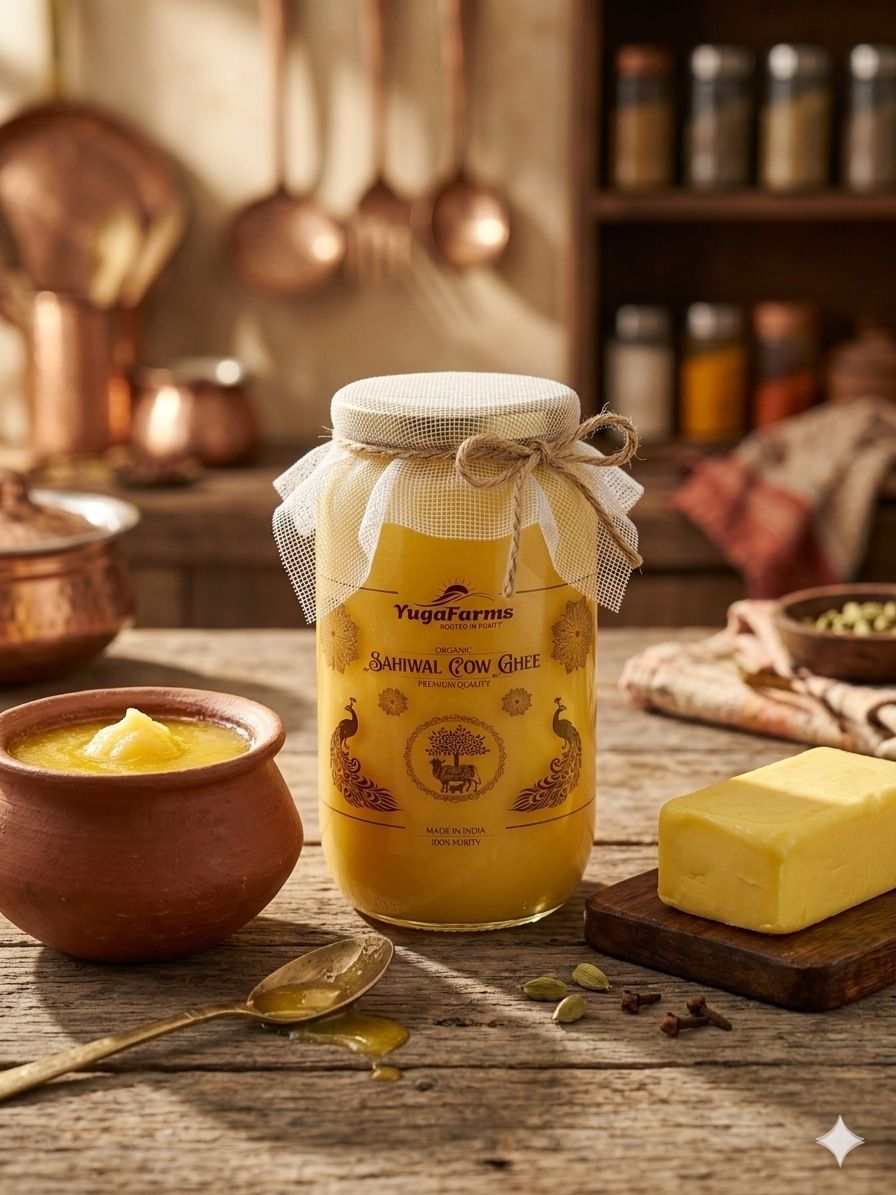
Ghee vs Butter: Which One Should You Actually Be Using?
Published by YugaFarms · June 2026 · 12 min read
My wife grew up in a household where ghee was non-negotiable. Every roti got a generous smear before it hit the plate. The dal had a tadka of desi ghee. Even the rice — a little ghee on top, always.
I grew up differently. My mother kept a yellow butter dish on the dining table. Amul salted butter. On toast, on parathas, sometimes sneaked off the block with a spoon when no one was looking.
When we got married and set up our own kitchen, we had to make a choice. Ghee or butter?
Took us a while to figure it out. And honestly, once we did — there was no going back.
If you're standing in the same crossroads right now, this one's for you.
First, What Are We Even Comparing?
Before we pit them against each other, let's be clear about what each of these actually is.
Butter is made by churning cream that's separated from cow's milk. It's roughly 80% fat, 16–18% water, and 2–4% milk solids (proteins and sugars). The water and milk solids are what make butter burn quickly at high temperatures.
Ghee is clarified butter taken one step further. You start with butter, heat it until the water evaporates and the milk solids settle to the bottom, then strain them out. What remains is almost pure fat — golden, fragrant, and shelf-stable without refrigeration.
But here's the part most people miss: not all ghee is equal.
The ghee our grandmothers made — and what we make at YugaFarms — starts from a completely different place. We begin with A2 milk from our Sahiwal cows, ferment it into curd overnight using a natural starter culture, churn it the old way in a wooden vessel (that's the bilona process), separate the hand-churned white butter, and then slow-cook it on a low flame until it turns into that deep golden ghee you know by smell alone.
Commercial ghee skips almost all of that. It's made from cream, not curd. And cream-based ghee and curd-based bilona ghee are fundamentally different animals — different fatty acid profiles, different butyrate content, different digestibility.
Keep that distinction in mind as we go.
The Smoke Point Question (The Biggest Practical Difference)
This is where ghee wins decisively, and it matters every single day in your kitchen.
Butter starts burning around 150°C (302°F). That's it. The moment you put butter in a hot pan and it goes brown and smells nutty — or worse, black and acrid — the milk proteins and sugars are burning. Burned fats produce compounds called aldehydes, which are genuinely harmful with regular exposure. So butter is really only safe for low-heat cooking, spreading, or finishing dishes.
Ghee, on the other hand, has a smoke point of around 250°C (482°F). Because the water and milk solids have been removed, there's nothing left to burn at normal cooking temperatures. You can roast vegetables in ghee at high heat, use it for deep frying, make a proper tadka — all without it breaking down.
This isn't a small thing. It's the reason Ayurveda always recommended ghee for cooking rather than butter. Ancient physicians didn't have smoke point charts, but they observed the results: food cooked in ghee felt lighter, was better tolerated, and didn't cause the heaviness that butter sometimes did.
The Lactose Question (Who Can Eat What)
A lot of people assume dairy is dairy and if you're lactose intolerant, none of it is for you. That's not entirely true.
Butter contains lactose and casein — the two components of milk that most people react to. Not in huge amounts, but enough to cause issues for people with sensitivity. Salted butter has slightly more milk solids than unsalted, which means slightly more lactose.
Good ghee has virtually no lactose or casein — because both are removed in the clarification process. The milk solids that settle at the bottom of the pan? That's where the lactose and casein live. They get strained out.
This is why many people who can't tolerate milk or even butter find that they can eat ghee without any issue. It's not a myth — it's chemistry.
One caveat: commercially made ghee sometimes isn't clarified thoroughly enough, and trace amounts of milk proteins remain. Traditionally made bilona ghee, slow-simmered with care, tends to be more completely clarified. Something worth knowing if lactose is a real concern for you.
The Fat Composition: What's Actually Inside
Both ghee and butter are primarily saturated fats — and yes, that word still makes some people nervous. But the saturated fat conversation has evolved a lot in the last decade, and it's worth understanding what's actually there.
Butter's fat breakdown (approximate):
- Saturated fat: ~63%
- Monounsaturated fat: ~26%
- Polyunsaturated fat: ~4%
- Trans fat: small amounts (naturally occurring, not the industrial kind)
Ghee's fat breakdown (approximate):
- Saturated fat: ~65%
- Monounsaturated fat: ~25%
- Polyunsaturated fat: ~5%
On paper they look similar. But ghee has a meaningful advantage in two specific areas.
Butyric acid. Ghee contains higher concentrations of short-chain fatty acids, especially butyric acid (butyrate), than butter does. Butyrate is what your colon cells prefer to use as fuel. It has anti-inflammatory properties, helps maintain the gut lining, and is linked to a healthier gut microbiome. Several studies on gut health now point to butyrate as genuinely important — and ghee is one of the richest dietary sources of it.
CLA (Conjugated Linoleic Acid). Ghee made from grass-fed or pasture-raised cows — which our Sahiwal cows are — tends to be higher in CLA than standard butter. CLA has been studied for its potential role in body composition and immune function.
Omega-3 to Omega-6 ratio. A2 bilona ghee from indigenous breeds tends to have a more favorable omega-3 to omega-6 ratio than commercial butter or ghee from crossbred cows. This matters because modern diets are typically too high in omega-6, which can contribute to chronic inflammation when the ratio is off.
The A2 vs A1 Protein Factor
This one specifically applies to ghee made from desi Indian cow milk.
Most commercial dairy — including most butter you'll find in stores — comes from crossbred or HF (Holstein Friesian) cows. These cattle predominantly produce A1 beta-casein protein. Some research suggests A1 protein breaks down into a peptide called BCM-7 during digestion, which may be associated with digestive discomfort and inflammation in some individuals.
Indigenous Indian breeds like Sahiwal, Gir, and Tharparkar produce A2 beta-casein protein. This protein behaves differently in the body — it doesn't produce BCM-7 and is generally considered easier to digest.
This is one of the main reasons we work exclusively with Sahiwal cows at our farm in Palwal. The milk is inherently different. And when that milk goes through the full bilona process — fermented, churned, clarified slowly — the resulting ghee carries all of those benefits forward.
Butter made from commercial dairy doesn't give you any of this.
Nutrition Side by Side
| Ghee (1 tbsp / 13g) | Butter (1 tbsp / 14g) | |
|---|---|---|
| Calories | ~120 kcal | ~102 kcal |
| Total Fat | 13g | 11.5g |
| Saturated Fat | 8g | 7.3g |
| Cholesterol | 33mg | 31mg |
| Vitamin A | ~438 IU | ~355 IU |
| Vitamin E | ~0.4mg | ~0.33mg |
| Vitamin K2 | Present | Lower |
| Lactose | Negligible | Present |
| Butyrate | Higher | Lower |
| Smoke Point | ~250°C | ~150°C |
The calorie difference is small. The real differences are in usability, digestion, and the quality of what's in those fats — especially when you're comparing A2 bilona ghee with regular commercial butter.
What Ayurveda Has Been Saying for 3,000 Years
Ayurvedic texts like Charaka Samhita and Ashtanga Hridayam are almost unanimously enthusiastic about ghee. It's described as one of the most beneficial of all fats — something that nourishes all seven dhatus (body tissues), improves ojas (vital essence), supports digestion, sharpens intellect, and calms the nervous system.
Butter gets a mention too, but always as a lesser preparation — good, but not as refined or as bioavailable as ghee.
The reasoning, when you decode it through a modern lens, actually makes a lot of sense. By removing the water and milk solids, you concentrate the beneficial lipids while eliminating the components most likely to cause digestive issues. The slow clarification process also seems to affect the fat structure in ways that make it easier for the body to absorb.
Interestingly, Ayurveda recommends ghee made from the curd of indigenous cows churned by hand — which is exactly what bilona ghee is. This wasn't an accident. It was the result of generations of observation about what actually helped people.
Cooking: Where to Use Each One
Use ghee for:
- High-heat cooking — sautéing, roasting, stir-frying
- Tadkas and tempering (the smoke point means your spices bloom without burning)
- Deep frying (yes, really — ghee is stable at frying temperatures)
- Spreading on hot rotis and parathas
- Adding to dal, khichdi, rice
- Taking a spoonful on an empty stomach in the morning (for those following Ayurvedic practices)
Use butter for:
- Baking, where the water content actually helps texture
- Cold applications — spreading on bread that won't be heated
- Western preparations like beurre blanc or finishing sauces where the milk solids add flavor
- Making compound butters (herb butters, garlic butter)
There's room for both in a kitchen. But if you're cooking Indian food at home and you're choosing a primary fat for daily use, ghee is the more practical, more digestible, and arguably more nutritious choice.
The Storage Question
One more practical point that most people overlook.
Butter needs refrigeration. Left at room temperature for more than a day or two (depending on climate), it goes rancid — the milk proteins break down and the flavor turns sour.
Ghee can be stored at room temperature for months — sometimes up to a year with proper storage in an airtight glass jar away from light. This is because there are no proteins or water left to spoil. Traditional Indian households kept a brass pot of ghee on the kitchen shelf, not in the fridge.
This was enormously practical before refrigeration existed. And it still matters today. Ghee is fundamentally more stable — which is actually a sign of its purity.
A Note on Quality
Everything I've written above assumes you're working with good ghee. And that qualifier matters more than most people realize.
Most ghee on supermarket shelves is made from cream — a much faster, cheaper process than bilona. It's not bad, exactly, but it doesn't carry the same butyrate levels, the same fatty acid profile, or the same A2 distinction as traditionally made ghee.
The bilona process takes almost 30 hours from start to finish. We ferment the milk overnight, churn it in the early morning hours, collect the white butter by hand, and then slow-simmer it on a wood fire until it clarifies into ghee. The yield from each batch is lower. The effort is higher. But the result is something genuinely different from what you'll find in a tin at a grocery store.
If you're going to make the switch from butter to ghee, it's worth making it a proper switch — to ghee that was actually made the right way.
So: Ghee or Butter?
For everyday Indian cooking — ghee, without question.
It handles heat better, digests more easily, keeps longer, and when it's made from A2 milk the traditional way, it brings things to the table that butter simply can't match.
Butter has its place — mostly in baking or in Western preparations where its specific properties are needed. But as a daily cooking fat for an Indian household? Ghee wins.
Your grandmother knew this. She just didn't have a smoke point chart to explain why.
Try YugaFarms A2 Sahiwal Bilona Ghee
Our ghee is made from the milk of Sahiwal cows raised on our farm in Palwal, Haryana. Fed on natural grass, no hormones, no shortcuts. The curd is churned by hand using the traditional bilona method. Every batch is small, slow, and made the way it used to be done.
First order? Use FIRSTGHEE for 8% off.
You Might Also Like
- The Bilona Method: Why Your Grandmother's Ghee Was Different
- A2 Bilona Ghee vs Regular Ghee: What's the Real Difference?
- Sahiwal A2 Cow Ghee: Why This Ancient Breed Makes the Finest Ghee
- Is A2 Bilona Ghee Good for Your Gut?
- Should You Eat Ghee on an Empty Stomach?
Frequently Asked Questions
Is ghee healthier than butter? For most people, yes — especially for cooking. Ghee has a much higher smoke point, contains negligible lactose, and is richer in butyrate. A2 bilona ghee from indigenous Indian breeds also brings additional benefits through its protein type and fatty acid profile that regular butter doesn't offer.
Can I substitute ghee for butter in baking? You can in most cases, but the results will differ slightly. Ghee has no water content (butter is ~18% water), so baked goods may come out a little denser or crispier. Use about 25% less ghee than butter by volume, or use equal amounts and add a tablespoon of water per cup to compensate.
Is ghee okay for people who are lactose intolerant? Generally yes. The clarification process removes the milk solids where lactose and casein reside. Most lactose-intolerant people tolerate well-made ghee without issues, though individual responses vary.
Why is A2 ghee more expensive than regular butter? A2 ghee, especially bilona-method ghee from desi breeds, requires significantly more milk, more time, and more labor than regular butter or even commercial ghee. The yield is lower. The process is slower. You're paying for a product that's fundamentally different from a factory-made alternative.
Does ghee raise cholesterol? This is a nuanced question. Ghee is high in saturated fat, which can affect LDL levels. However, it also contains HDL-supporting fatty acids, CLA, and fat-soluble vitamins. Research on ghee and cholesterol specifically (as opposed to saturated fat generally) suggests that moderate consumption as part of a balanced diet isn't problematic for most healthy adults. We have a full breakdown in our heart health blog.
Can I use ghee for deep frying? Yes. Ghee's high smoke point (~250°C) makes it stable for deep frying. Traditionally, Indians used ghee for frying puris, jalebis, and sweets. It imparts a distinctive flavor and is more stable than many vegetable oils at high temperatures.
How long does ghee last compared to butter? Butter refrigerated: 1–3 months. Butter at room temperature: 1–2 days in summer. Ghee at room temperature in an airtight glass jar: 6–12 months. This difference comes from ghee's complete removal of water and milk proteins — there's nothing left to spoil.
What does ghee taste like compared to butter? Ghee has a nuttier, richer, more concentrated flavor than butter. The slow clarification creates a slight caramelized undertone. Many people who try good bilona ghee for the first time describe it as the "real" taste they were looking for — the way ghee smells in a Haryanvi kitchen in the morning.
YugaFarms is a farm-based food brand in Palwal, Haryana. We produce A2 Sahiwal Bilona Ghee, Desi Buffalo Bilona Ghee, and raw multifloral honey using traditional methods. FSSAI and ISO 9001:2015 certified.