
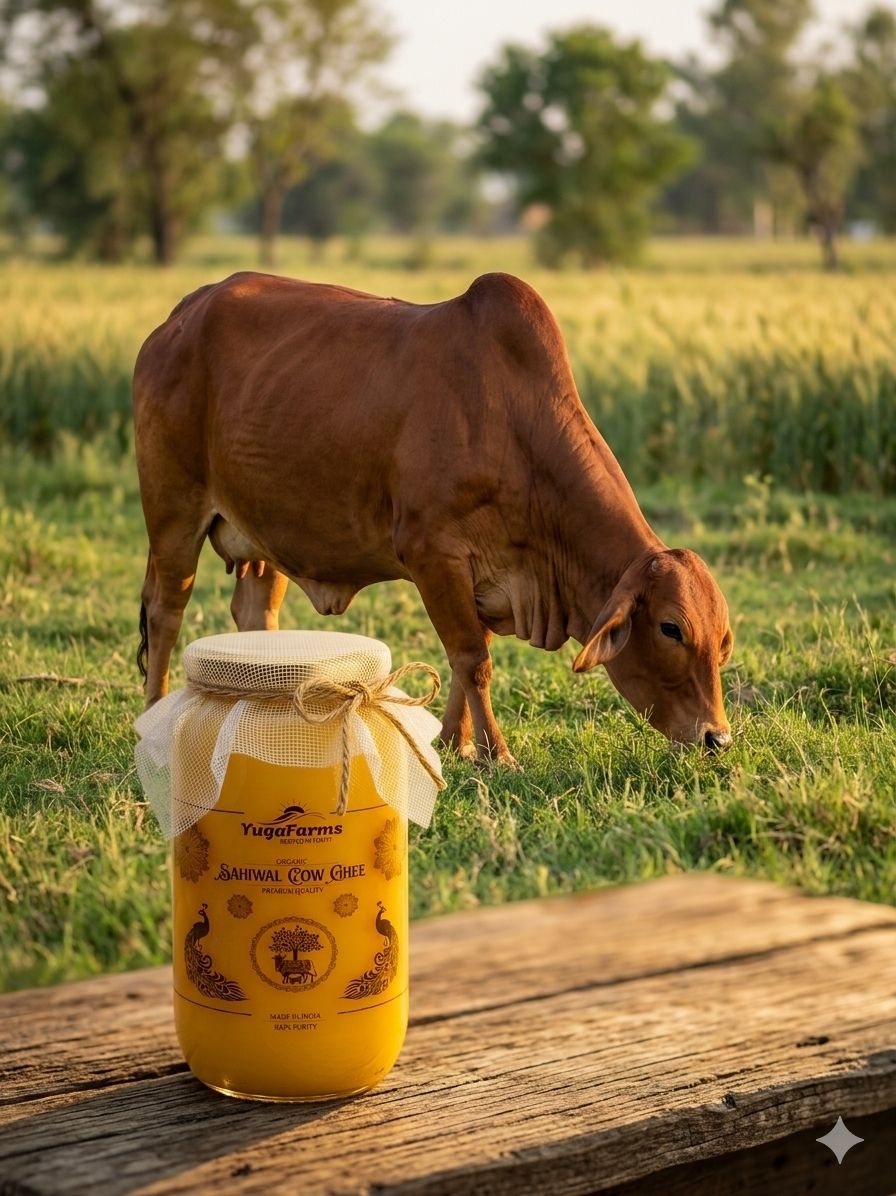
Sahiwal A2 Cow Ghee: Why This Ancient Indian Breed Makes the Finest Ghee in the World
Published by YugaFarms · June 2026 · 9 min read
Most ghee conversations start and end with the word "A2." But within the world of A2 ghee, there is a hierarchy — and at the top of it, quietly and without much fanfare, sits the Sahiwal cow.
At YugaFarms, we source exclusively from Sahiwal cows. Not because it's a marketing angle, but because once you understand the breed — its history, its milk composition, its temperament, its deep rootedness in the subcontinent — the choice becomes obvious. There is no better cow for ghee in India. There might not be a better cow for ghee anywhere.
This is the full story of the Sahiwal: where she comes from, what makes her milk different, why the ghee she produces is in a category of its own, and how to know whether the jar you're buying actually came from her.
The Sahiwal Cow: India's Most Underrated Dairy Breed
The Sahiwal is one of the oldest dairy cattle breeds on the subcontinent. Her origins trace back to the dry, sun-scorched Punjab region — specifically the Montgomery district, now part of Pakistan, which was renamed Sahiwal after the breed itself. For centuries, she was kept in large herds by professional herdsmen known as Charwahas, who moved with the cattle across pastoral land and understood the animal deeply.
With the introduction of irrigation systems across Punjab, the nature of cattle keeping changed. The Sahiwal moved from open herds to smaller family farms, where she became the gold standard of the dairy cow: productive, calm, hardy, and resistant to the tropical diseases — particularly tick-borne illnesses — that ravaged other breeds. She was so well-regarded that she was eventually exported to Australia, Africa, the Caribbean, and across Southeast Asia for cross-breeding programmes.
Today, purebred Sahiwal herds are maintained across India — in Punjab, Haryana, Uttar Pradesh, Bihar, and Madhya Pradesh — at institutions including the National Dairy Research Institute (NDRI) and the Indian Agricultural Research Institute (IARI). She is officially recognised as one of the finest dairy breeds in the country.
And yet, in the supermarket, you'll find ghee labelled simply "desi cow" with no breed mentioned at all.
What Makes Sahiwal Milk Different
Not all A2 milk is created equal. The A2 designation tells you the protein type — but it says nothing about butterfat content, nutritional density, or the quality of the milk itself.
The Sahiwal's milk is exceptional by almost every measure.
Butterfat content of 4.5% to 5.5%. This is significantly higher than hybrid or commercial breeds, which typically yield milk at 3–3.5% fat. Butterfat is what becomes ghee. Higher butterfat means richer, more aromatic ghee — and crucially, it means more of the fat-soluble vitamins A, D, E, and K2 that concentrate in the fat portion of milk.
Daily yield of 6 to 10 kg per day. Sahiwal cows are exceptional producers for a native breed — capable of 8 to 10 kg per day on well-managed farms across a 10-month lactation. This is why they became so prized: they combine the quality profile of a traditional Indian breed with the productivity needed to sustain a dairy operation.
Naturally high A2 beta-casein protein. The Sahiwal is a purebred zebu (humped) Indian cow — one of the breeds most reliably and extensively documented as producing exclusively A2 beta-casein milk. There is no ambiguity here, as there can be with some mixed or undocumented "desi" breeds.
Milk rich in beta-carotene. Sahiwal cows that graze on natural pasture and forage produce milk with significantly elevated beta-carotene levels — the precursor to vitamin A. This is what gives Sahiwal ghee its characteristic deep golden-yellow colour. Pale white ghee almost certainly did not come from a pasture-raised Sahiwal.
Why Sahiwal Ghee Has a Distinct Flavour and Texture
If you have ever tasted ghee made from Sahiwal milk and compared it to commercial ghee, the difference is not subtle. It is immediate.
The colour is deep gold, sometimes with an amber quality in certain seasons. The aroma is rich and nutty — there is a complexity to it, a slight sweetness and a lingering warmth in the throat that commercial ghee simply does not have. The texture, when solid, is slightly grainy — small fatty crystals formed during slow cooling, which is a signature of properly made bilona ghee from high-fat milk.
These characteristics are not accidental. They come directly from the breed.
The high butterfat content means there is more fat to work with during churning. The traditional bilona process — which we will revisit in a moment — converts this fat through fermentation before clarification, which develops complex flavour compounds that no shortcut method can replicate. The result is ghee that tastes like something made by someone's grandmother. Because, in the way that matters most, it was.
The Bilona Method and Why It Matters Specifically for Sahiwal Ghee
You can have the best milk in the world and ruin it with the wrong process. This is why the bilona method matters — not just as a tradition, but as the only technique that honours what Sahiwal milk actually is.
The bilona process works like this:
Step 1 — Fresh milk collection. Sahiwal cows are milked in the morning, ideally after the calf has had its share. This is not just sentimentality — a cow that has let down her milk for her calf produces milk with a different hormonal and compositional profile than one that has been mechanically extracted under stress.
Step 2 — Gentle heating and cooling. Fresh milk is heated slowly to eliminate pathogens, then cooled to approximately 30–35°C — the sweet spot for curd culture to activate.
Step 3 — Curd fermentation overnight. A small spoonful of live curd from the previous batch is added and the milk is left undisturbed for 8–12 hours. This fermentation step is what separates bilona ghee from all commercial ghee. The live cultures transform the milk, introducing beneficial enzymes and beginning the breakdown of proteins and fats in ways that enhance both nutrition and digestibility.
Step 4 — Hand-churning with the bilona. The set curd is churned using a traditional wooden churner — always in a specific alternating direction — until white butter (makhan) separates and floats to the surface. This can take 45 minutes to an hour. It is work. It cannot be meaningfully replicated by machine without sacrificing the texture and temperature control that makes it what it is.
Step 5 — Slow clarification on low heat. The makhan is heated slowly on a low flame until the water evaporates, the milk solids settle and separate, and what remains is pure, golden, clarified ghee. The smell at this stage — slightly caramelised, deeply nutty — is unlike anything else in a kitchen.
The entire process, from fresh milk to jarred ghee, takes close to 24 hours. It requires approximately 25 to 30 litres of Sahiwal milk to produce a single litre of bilona ghee — nearly double the yield loss of cream-separated commercial ghee.
This is why genuine A2 Sahiwal bilona ghee is priced the way it is. It is not a margin decision. It is mathematics.
7 Specific Benefits of A2 Sahiwal Cow Ghee
1. Superior Digestibility — No A1 BCM-7 Peptide
Sahiwal milk contains exclusively A2 beta-casein protein. When digested, A1 beta-casein (from hybrid breeds) releases a peptide called BCM-7, which is linked to digestive discomfort, bloating, and gut inflammation in sensitive individuals. A2 milk does not produce this peptide in the same way. For people who experience heaviness or discomfort after consuming regular dairy or ghee, switching to A2 Sahiwal ghee is frequently the change that makes the most immediate difference.
2. Butyric Acid for Gut and Colon Health
Bilona ghee from high-fat Sahiwal milk is rich in butyric acid (butyrate) — a short-chain fatty acid that is the primary fuel for the cells lining the colon. Butyrate plays a direct role in reducing gut inflammation, maintaining the intestinal lining, and supporting a healthy microbiome. It's one of the most studied compounds in gut health research, and it's most abundant in traditionally made ghee from high-fat milk.
3. Fat-Soluble Vitamins A, D, E and K2
The fat in Sahiwal ghee carries vitamins that are difficult to obtain in meaningful quantities from most modern diets. Vitamin K2 — essential for directing calcium into bones rather than arteries — is virtually absent from processed foods and present in significant amounts only in dairy from pasture-raised animals. Sahiwal cows that graze on open land naturally produce milk higher in these vitamins. The bilona process, which retains fat integrity rather than mechanically separating it, preserves them.
4. Conjugated Linoleic Acid (CLA) for Metabolism Support
CLA is a naturally occurring fatty acid found in higher concentrations in milk from grass-fed native breeds. Research has linked it to potential benefits in healthy body composition and immune function. Sahiwal ghee from pasture-fed cows contains meaningfully more CLA than commercial ghee from confined hybrid cattle.
5. Ayurvedic Rasayana Properties
In classical Ayurvedic texts, ghee from the milk of native Indian cows — specifically prepared using the curd-churning method — is classified as a rasayana: a substance that promotes longevity, enhances cognitive function, and restores vitality across all constitutions. Sahiwal ghee, prepared by the bilona method, is considered the closest modern equivalent to the ghee described in these texts. Its properties according to Ayurveda include agni deepana (strengthening digestive fire), medhya rasayana (brain tonic), and balancing of Vata and Pitta doshas.
6. High Smoke Point for Safe High-Heat Cooking
At approximately 250°C, Sahiwal bilona ghee has one of the highest smoke points of any cooking fat. At this temperature, vegetable oils and seed oils are already producing harmful oxidation by-products. Ghee remains stable, making it the safest and most appropriate fat for tadka, deep frying, and high-heat sautéing. It does not produce trans fats or acrylamide under normal Indian cooking conditions.
7. Anti-inflammatory Omega Fatty Acid Profile
Sahiwal ghee from grass-fed cows contains omega-3 and omega-6 fatty acids in a balanced ratio — closer to the ratios found in traditional diets. Compared to refined seed oils, which carry an extremely high omega-6 to omega-3 ratio and drive systemic inflammation when over-consumed, ghee is a far more metabolically neutral cooking fat.
Sahiwal vs Gir vs Regular Desi Cow Ghee: What's the Difference?
If you've been comparing A2 ghee brands, you've likely seen references to Gir cow ghee and wondered how it compares to Sahiwal.
Both Gir and Sahiwal are purebred Indian zebu breeds that produce exclusively A2 milk. Both are excellent sources of bilona ghee. The differences are real but subtle:
Sahiwal originates from Punjab — a cow of the northern plains. Her milk has a higher butterfat content (4.5–5.5%) and tends to produce ghee with a slightly more grainy texture and a pronounced nutty aroma. The flavour is rich and complex.
Gir originates from Gujarat's Gir forest region. Her milk is excellent and her ghee is slightly lighter in colour and flavour — still exceptional, but with a different character.
For people in North India — where the Sahiwal has grazed for thousands of years, where the climate, the fodder, and the farming culture have shaped the breed — Sahiwal ghee carries a certain sense of rightness. It is the ghee of this land.
Regular "desi cow" ghee with no breed specified is a different matter entirely. Without knowing the breed, you cannot know whether the milk was A2, what the butterfat content was, or whether the "traditional" method claimed on the label was actually used. Breed transparency is not a marketing extra — it is the baseline of accountability.
How to Identify Genuine Sahiwal A2 Bilona Ghee
Given how freely the terms "A2," "bilona," and "desi cow" are used, here is a practical guide to verifying what you're actually buying.
Colour: deep golden, not pale yellow. The deep colour in Sahiwal ghee comes from beta-carotene in pasture grass. A cow that is eating natural fodder and grazing on open land produces milk with visibly higher beta-carotene. If the ghee is white or very pale, it did not come from a pasture-fed Sahiwal.
Texture: grainy when solid. Genuine bilona ghee from high-fat Sahiwal milk crystallises naturally as it cools. When you open a jar stored at room temperature (not refrigerated), you should see a slightly granular texture — tiny, soft crystals throughout the ghee. This is not a defect. It is the signature of real bilona ghee.
Aroma: nutty, caramelised, complex. Heat a teaspoon in a small pan. Genuine Sahiwal bilona ghee should fill the kitchen with a warm, nutty, slightly sweet aroma within seconds. If it smells flat or neutral, the milk was likely not from a Sahiwal, or the bilona process was not used.
Breed documentation. Ask the brand — or check their website — whether they can specify the breed, the farm or region of sourcing, and the process used. At YugaFarms, we source exclusively from Sahiwal cows in Haryana and can tell you exactly how our ghee is made.
FSSAI certification and lab reports. Any genuine producer selling food in India should hold a valid FSSAI license. Beyond that, a brand willing to share third-party lab test results — purity, HMF levels, fatty acid profile — is demonstrating accountability that most commercial producers avoid. Our lab reports are available openly at yugafarms.com/lab-reports.
How Much Sahiwal Ghee Should You Consume Daily?
Ghee is a fat. A deeply nutritious, carefully sourced fat — but a fat nonetheless, and it should be treated with appropriate respect rather than consumed without thought.
For a healthy adult, 1 to 2 teaspoons per day is a reasonable and beneficial amount. Used as a cooking fat for tadka, on roti, or stirred into dal, this quantity is consumed naturally without any special effort.
Traditional Ayurvedic practice sometimes recommends a teaspoon on an empty stomach first thing in the morning — on the basis that ghee consumed before food coats the digestive tract and stimulates agni (digestive fire) before the day's eating begins. Many people who follow this practice report improved digestion and more consistent energy through the morning.
For children over 2, a small amount of ghee added to khichdi, dal, or roti daily is excellent. Ghee has traditionally been one of the first fats introduced to weaning children in Indian households, and for good reason — the fat-soluble vitamins and butyric acid are particularly valuable during growth.
Why YugaFarms Uses Sahiwal Exclusively
We are a small-batch farm. We do not produce hundreds of tonnes of ghee. What we produce, we produce carefully — in batches small enough that the person making it can maintain the quality of every jar.
We chose Sahiwal cows not because the name tests well in a marketing meeting, but because the milk is genuinely superior for the ghee we want to make. The depth of flavour, the colour, the texture — they come from the breed. Our job is simply not to ruin them.
Our cows are pasture-fed, ethically cared for, and free from synthetic hormones. The calves are allowed to feed before milking. The ghee is made by hand, one batch at a time, in Palwal, Haryana.
We are FSSAI certified, ISO 9001:2015 certified, and our lab reports are public. If you have questions about our process, sourcing, or any batch of ghee you receive, contact us directly at support@yugafarms.com or call +91 96710 12177.
Frequently Asked Questions
Is Sahiwal ghee better than Gir cow ghee? Both are excellent. Sahiwal tends to have a slightly higher butterfat content and a more pronounced nutty flavour profile. Gir ghee is lighter and more widely available. Neither is categorically superior — it depends on personal taste and sourcing quality. What matters most is that both breed and process are clearly stated by the producer.
Why does Sahiwal bilona ghee sometimes look grainy or semi-solid? This is natural crystallisation, caused by the high content of saturated fatty acids in the ghee cooling slowly. It is a mark of quality, not spoilage. To reliquefy, simply place the jar in a bowl of warm water for 10 minutes.
Can I use Sahiwal ghee for deep frying? Yes. With a smoke point of approximately 250°C, it is one of the most stable cooking fats for high-heat use. It does not oxidise or produce harmful compounds at normal frying temperatures the way refined vegetable oils do.
How long does it last? Stored in an airtight container, away from moisture and direct sunlight, Sahiwal bilona ghee has a shelf life of 12 to 18 months at room temperature. Refrigeration is not necessary and will cause the ghee to harden, which does not affect quality but makes scooping inconvenient.
What is the difference between Sahiwal ghee and regular cow ghee at the supermarket? The differences are significant: breed (Sahiwal A2 vs unspecified hybrid, likely A1), process (bilona curd-churning vs cream separation), nutritional profile (higher butyrate, CLA, fat-soluble vitamins), flavour (complex, nutty vs flat, neutral), and accountability (documented sourcing vs none). They share a name — ghee — but are functionally different products.
The Bottom Line
The Sahiwal cow has been feeding families across Punjab and Haryana for centuries. She is not a new discovery or a wellness trend. She is the original dairy cow of this land — patient, hardy, and generous with milk that is richer and more nourishing than anything a modern hybrid breed can produce.
Ghee made from her milk, by the bilona method, from a farm that knows her by name rather than by batch number, is the real thing. Not as a luxury, but as food the way food is supposed to be.
If you have never tried genuine Sahiwal bilona ghee, we'd invite you to try it once. Open the jar and smell it before you do anything else. That alone will tell you everything about what you've been missing.
YugaFarms produces small-batch A2 Sahiwal Bilona Ghee from our farm in Palwal, Haryana. FSSAI certified · ISO 9001:2015 · Lab reports publicly available. Use code FIRSTGHEE for 8% off your first order.
Tags: sahiwal cow ghee, A2 sahiwal cow ghee, sahiwal cow ghee benefits, sahiwal bilona ghee, pure sahiwal ghee online, sahiwal a2 ghee India, buy sahiwal cow ghee, sahiwal cow milk ghee, best a2 ghee India, desi cow ghee sahiwal, yugafarms sahiwal ghee, sahiwal vs gir cow ghee