
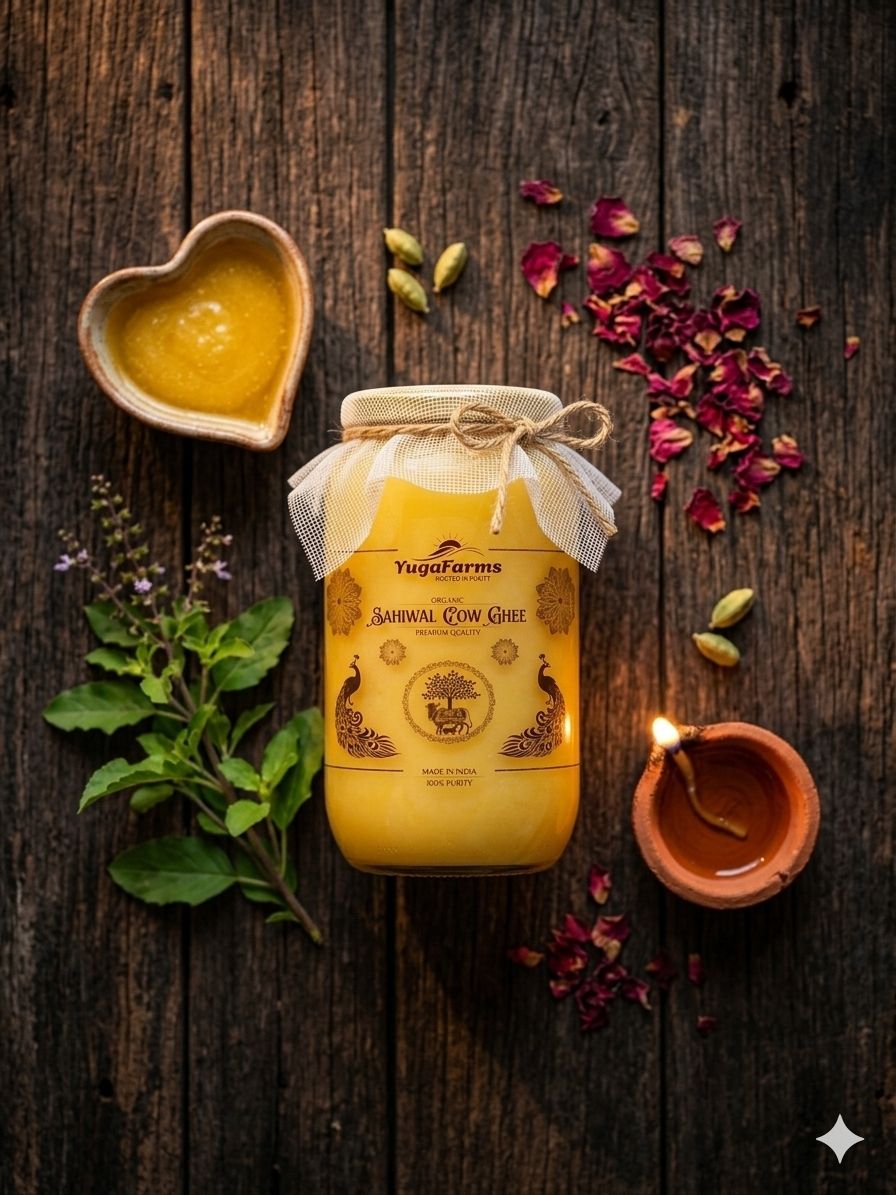
Is A2 Bilona Ghee Good for Your Heart and Cholesterol? What the Science Actually Says
Published by YugaFarms · June 2026 · 11 min read
There's a question almost every Indian family has argued about at the dinner table.
Someone picks up the ghee spoon. Someone else says — Put that down. Your cholesterol is already high.
For nearly fifty years, ghee has been the villain in that conversation. The fatty enemy. The thing your doctor quietly suggested you avoid. And for many Indian households, removing ghee from the kitchen felt like the responsible, modern thing to do.
But here's the problem: India's rates of heart disease didn't fall when we reduced ghee. They rose. And in many traditional communities that never stopped using ghee — where it remained the primary cooking fat alongside whole grains, dal, and seasonal vegetables — cardiovascular disease remained lower than in regions that had switched to refined vegetable oils.
Something doesn't add up.
This blog is our attempt to work through what science and Ayurveda actually say about A2 Bilona Ghee, cholesterol, and heart health — not with marketing claims, and not with fear-based dismissals. Just the honest picture.
Why Ghee Got the Blame in the First Place
To understand where the ghee-is-bad-for-your-heart story came from, it helps to go back to the 1960s and 70s.
A series of influential (and later heavily criticised) nutritional studies concluded that dietary fat — especially saturated fat — raised cholesterol and caused heart disease. The logic seemed clean: eat fat → cholesterol goes up → heart disease follows.
Ghee is almost entirely fat. More specifically, it's saturated fat. So it got lumped into the same category as processed butter, margarine, and trans fats — which was both scientifically sloppy and deeply consequential for Indian food culture.
In the decades that followed, nutritional science has significantly revised this position. A landmark 2010 meta-analysis in the American Journal of Clinical Nutrition (Siri-Tarino et al.) reviewing 21 studies found no significant evidence that saturated fat as a category is associated with increased cardiovascular disease risk. The picture is far more nuanced.
What matters is not just whether a food contains saturated fat — but what type of saturated fat, what other compounds it carries, how it was made, and what you're eating instead of it.
This is exactly where A2 Bilona Ghee becomes interesting.
What Cholesterol Actually Is — and Why the Old Story Was Oversimplified
Before we talk about ghee, it helps to understand cholesterol a little better than we were taught.
Cholesterol is not a poison. It is a substance your body makes itself — and needs — for building cell membranes, producing hormones, and making vitamin D. The liver produces roughly 80% of the cholesterol in your body regardless of what you eat.
When doctors measure cholesterol, they're actually measuring lipoproteins — the tiny packages that carry cholesterol through your bloodstream. The two most commonly discussed are:
LDL (Low-Density Lipoprotein) — often called "bad" cholesterol. But even here, research has refined our understanding. There are two types of LDL particles: small, dense LDL (associated with arterial plaque) and large, fluffy LDL (largely benign). Most dietary fat raises large LDL, not the dangerous small dense kind.
HDL (High-Density Lipoprotein) — called "good" cholesterol because it helps transport excess cholesterol out of the bloodstream and back to the liver for disposal. Higher HDL is associated with lower cardiovascular risk.
Triglycerides — another blood fat, elevated primarily by excess sugar and refined carbohydrates, not dietary fat.
The old model said: eat saturated fat → total cholesterol rises → heart disease follows. The newer, more accurate model says: the ratio of LDL to HDL, the type of LDL particles, the presence of inflammation, and overall dietary context are what matter.
With that foundation, let's look at what A2 Bilona Ghee actually does.
What Makes A2 Bilona Ghee Different from Regular Ghee?
Not all ghee is the same. Commercial ghee found in supermarkets is often made from A1 milk (from crossbred or hybrid cow breeds), using an industrial cream-separation process that skips fermentation entirely. The result is a fat that lacks many of the bioactive compounds that make traditional ghee nutritionally meaningful.
A2 Bilona Ghee — the kind made at YugaFarms from Sahiwal cow milk — is fundamentally different in two ways:
1. The Source: A2 Milk from Indigenous Desi Cows
Sahiwal cows, like Gir and Tharparkar, naturally produce milk containing only A2 beta-casein protein. Unlike A1 milk from hybrid breeds, A2 milk does not release BCM-7 (beta-casomorphin-7) during digestion — a peptide linked to gut inflammation and potential cardiovascular risk in sensitive individuals.
2. The Process: Traditional Bilona Method
In the bilona method, milk is first fermented into curd overnight, then the curd is hand-churned with a wooden churner (bilona) to extract butter, which is then slow-cooked into golden ghee. This curd-churning step is critical — it preserves conjugated linoleic acid (CLA), fat-soluble vitamins, and antioxidants that are degraded or lost in industrial processing.
The result is a ghee that contains a nutritional profile that mass-produced commercial ghee simply cannot match.
The Compounds in A2 Bilona Ghee That Actually Matter for Heart Health
Conjugated Linoleic Acid (CLA)
CLA is a naturally occurring fatty acid found in ghee from pasture-raised, traditionally cared-for desi cows. Research has shown that CLA may help:
- Reduce LDL cholesterol (particularly the small, dense type)
- Raise HDL cholesterol
- Reduce arterial inflammation
- Slow the development of atherosclerosis (arterial plaque)
Studies on bilona-method ghee have found CLA levels of around 2.5% — significantly higher than direct-cream commercial ghee at approximately 0.7%. That gap is not trivial.
Butyric Acid
Butyric acid is a short-chain fatty acid with well-documented anti-inflammatory properties. In the context of heart health, chronic inflammation is one of the most significant risk factors for cardiovascular disease — arguably more important than cholesterol alone. Butyric acid's ability to suppress inflammatory pathways is one reason traditional ghee consumption has been associated with reduced, not increased, cardiovascular risk in population studies.
Omega-3 and Omega-6 Fatty Acids
Bilona ghee has been found to have an omega-3 to omega-6 ratio of approximately 0.69 — significantly higher than direct-cream ghee at around 0.5. A better omega-3:omega-6 ratio supports a less inflammatory internal environment, which is directly relevant to heart health.
DHA
Bilona ghee contains measurably higher levels of DHA (docosahexaenoic acid) — an omega-3 fatty acid associated with reduced risk of coronary heart disease. DHA is one of the reasons that fish oil supplements are commonly recommended for cardiovascular health. Traditional bilona ghee provides a plant-accessible dietary source of this compound.
Fat-Soluble Vitamins: A, D, E, and K2
Vitamin K2, in particular, is notable: it activates proteins that direct calcium into bones and teeth — and away from arterial walls. Arterial calcification (calcium deposits in blood vessels) is a direct contributor to cardiovascular disease. The K2 present in properly made ghee helps prevent this calcification, making ghee genuinely protective for arteries.
What Does Indian Research Actually Show?
One of the most interesting data points comes not from labs but from populations.
Traditional rural Indian communities that maintained ghee as their primary cooking fat — alongside high-fibre whole grains, legumes, and seasonal vegetables — historically showed significantly lower rates of cardiovascular disease than urban populations that switched to refined vegetable oils.
The Indian Heart Association and multiple cardiologists have begun publicly reassessing ghee's role. Cardiologist Dr. Alok Chopra referred to pure ghee as the "Big Daddy of Oils" for its role in weight management, digestion, and heart health when consumed in moderation. This is not a fringe position — it reflects a broader shift in nutritional understanding that has been building for over a decade.
In a 2018 study in the European Journal of Clinical Nutrition, researchers found no clear evidence that ghee raises cholesterol levels when consumed as part of a balanced diet. Multiple Indian studies have found that including traditional cow ghee in the diet at moderate levels (up to 10% of dietary fat) actually improved the overall lipid profile — reducing total cholesterol, LDL, and triglycerides — while maintaining or raising HDL.
The Real Villains: Refined Vegetable Oils
Here's the part of the conversation that often gets skipped.
When Indian households moved away from ghee in the 1980s and 90s, they didn't replace it with nothing. They replaced it with refined vegetable oils — sunflower, soybean, cottonseed, and eventually palm oil. These oils are:
- Produced through industrial chemical extraction processes involving hexane and bleaching agents
- High in omega-6 fatty acids, which in excess promote inflammatory pathways
- Prone to oxidation at high cooking temperatures, forming harmful aldehydes and free radicals
- Completely devoid of the vitamins, CLA, and butyrate that traditional ghee contains
The Indian population's dramatic increase in heart disease over the past four decades coincides directly with the shift away from traditional fats toward refined industrial oils. Correlation isn't causation — but the pattern is striking enough that researchers are taking it seriously.
Does This Mean Ghee Is Safe for Everyone with High Cholesterol?
This is where we want to be honest with you, not just encouraging.
A2 Bilona Ghee is not a medicine. It is a food. And like all foods, context matters.
If your cholesterol is elevated and you're already on medication, speak to your doctor before making significant dietary changes. Ghee will not replace a statin or override a serious lipid disorder.
If your LDL is borderline and you're looking to improve your overall dietary pattern, replacing refined oils with 1–2 teaspoons of A2 Bilona Ghee per day is almost certainly a net improvement — not a risk. The research supports this.
If you're eating an otherwise high-calorie, high-sugar diet, adding ghee on top of that won't fix the underlying problem. The anti-inflammatory benefits of butyrate and CLA work best when they're part of a genuinely nourishing diet.
The quality of ghee matters enormously. Adulterated ghee — which contains added vegetable oil, animal fat, or other adulterants — carries none of the benefits described above and could genuinely harm your lipid profile. FSSAI data has historically shown significant adulteration in packaged ghee products. This is precisely why lab-tested, farm-produced bilona ghee from a transparent source is worth seeking out.
What Ayurveda Understood Centuries Ago
Ayurvedic texts have described ghee — called ghrita — as a hridya (heart-nourishing) food for thousands of years. Classical Ayurvedic pharmacopoeia prescribed ghee not just as a cooking medium but as a vehicle for delivering medicinal compounds to the body's deepest tissues.
The traditional view was never that ghee should be avoided. It was that ghee should be pure, consumed in appropriate quantities, and used as part of a whole-food diet. Ghee in a khichdi with vegetables and dal was considered deeply nourishing. Ghee added to fried, processed, or sugar-heavy food — not recommended.
The Ayurvedic distinction was between ojas (vital nourishment that sustains health) and ama (undigested toxins that burden the system). Pure ghee, used wisely, was considered an ojas-building food. This isn't mysticism — it maps onto what modern research is now confirming about the difference between high-quality traditional fats and industrial processed fats.
A Practical Guide: How to Use A2 Bilona Ghee for Heart Health
1 teaspoon on an empty stomach in the morning This is the most commonly cited Ayurvedic recommendation. It lubricates the digestive system, triggers bile production (which supports cholesterol metabolism), and begins the day with a healthy dose of butyric acid and fat-soluble vitamins.
Add to cooked grains, dal, and vegetables A small knob of ghee on hot rice or dal makes the meal more nutritious — it improves absorption of fat-soluble vitamins from the food and slows the glycaemic impact of carbohydrates, reducing blood sugar spikes. Blood sugar management is directly connected to cardiovascular health.
Use for tadka and light sautéing instead of refined oil Ghee's smoke point of approximately 250°C makes it one of the most stable cooking fats available. At high heat, refined oils oxidise and produce harmful compounds. Ghee does not.
Keep quantities sensible: 1–2 teaspoons per meal The research supporting ghee's cardiovascular benefits is based on moderate consumption. More is not automatically better. The goal is to replace other fats, not stack ghee on top of them.
Give it 4–6 weeks Meaningful changes in lipid profiles from dietary shifts typically show up over several weeks, not days. If you're monitoring your cholesterol, establish a baseline before you start and check again after a couple of months of consistent, moderate use.
Comparison: A2 Bilona Ghee vs Refined Vegetable Oil
| Aspect | A2 Bilona Ghee | Refined Vegetable Oil |
|---|---|---|
| Processing | Traditional, minimal (curd → churned butter → slow-cooked) | Industrial chemical extraction, deodorising, bleaching |
| CLA Content | ~2.5% | 0% |
| Butyric Acid | Present | Absent |
| Omega-3:Omega-6 Ratio | ~0.69 (favourable) | <0.1 (highly pro-inflammatory) |
| Fat-Soluble Vitamins | A, D, E, K2 | Mostly removed in processing |
| Smoke Point | ~250°C, highly stable | 160–200°C, oxidises easily |
| Impact on HDL | Supports or increases | Often decreases |
| BCM-7 | Absent (A2 protein only) | N/A |
Frequently Asked Questions
Q: Does ghee increase LDL cholesterol? A: In moderate amounts, traditional bilona ghee has not been shown to raise LDL cholesterol in population studies. It may raise large, fluffy LDL (considered benign) while improving HDL. The dangerous small, dense LDL particles are more closely linked to sugar and refined carbohydrate intake than to traditional dairy fats.
Q: Is ghee safe for someone with a heart condition? A: For most people, moderate consumption of pure A2 Bilona Ghee (1–2 teaspoons per day) as part of a whole-food diet is considered safe and may even be beneficial. Anyone with a diagnosed cardiovascular condition should consult their cardiologist before making dietary changes.
Q: How is A2 Bilona Ghee different from regular ghee for heart health? A: The bilona process preserves significantly higher levels of CLA (2.5% vs 0.7% in commercial ghee) and maintains a better omega-3:omega-6 ratio. A2 milk from indigenous breeds also avoids BCM-7, a peptide linked to gut and cardiovascular inflammation in some research. These differences are nutritionally meaningful.
Q: Can ghee replace cholesterol medication? A: No. Ghee is a food, not a pharmaceutical intervention. If you have clinically elevated cholesterol and are prescribed medication, do not discontinue it based on dietary changes alone without your doctor's guidance.
Q: How much A2 Bilona Ghee should I eat per day? A: Most traditional recommendations and modern research converge on 1–2 teaspoons per meal, or 2–3 teaspoons across the day. This assumes you're replacing other fats, not adding ghee on top of a high-fat diet.
Q: Which is better for heart health — ghee or olive oil? A: Both are legitimate healthy fats, but they serve different purposes. Olive oil is excellent for cold use and light cooking. Ghee is superior for high-heat Indian cooking (tadka, sautéing) because of its high smoke point. For Indian kitchens, replacing refined vegetable oils with ghee for high-heat cooking while using cold-pressed oils for finishing and dressings is a sensible approach.
Q: Is daanedaar (grainy) ghee purer? A: Yes — the grainy or crystalline texture of properly made bilona ghee is a result of the curd-churning process and slow cooling. It is one of the physical indicators of traditionally made, unadulterated ghee. Commercial ghee is often smooth and uniform because it's made by industrial cream separation and filtered differently.
The Bottom Line
The story that ghee is bad for your heart is not supported by the evidence — not when the ghee is pure, made from A2 milk, and prepared using the traditional bilona method.
What the research actually shows is this:
- Traditional bilona ghee is rich in CLA, butyric acid, omega-3 fatty acids, vitamin K2, and other compounds that are actively cardioprotective
- Moderate consumption of traditional ghee has not been shown to raise dangerous LDL particles or increase cardiovascular risk
- The omega-3:omega-6 ratio in bilona ghee is significantly more favourable than in refined vegetable oils
- The population-level shift away from ghee toward refined industrial oils corresponds to a dramatic rise in heart disease across India
- The quality of ghee matters enormously — adulterated or industrial ghee carries none of these benefits
Don't let a half-century-old misunderstanding keep you away from one of India's most nourishing traditional foods.
Use it moderately. Use it consistently. Make sure it's real.
At YugaFarms in Palwal, Haryana, our A2 Bilona Ghee is made from the milk of our own Sahiwal cows using the traditional hand-churning process — the same way it has been made in Indian homes for generations. Every batch is lab-tested and FSSAI certified. No adulteration. No shortcuts.
Explore our A2 Sahiwal Bilona Ghee →
First order? Use code FIRSTGHEE for 8% off.