
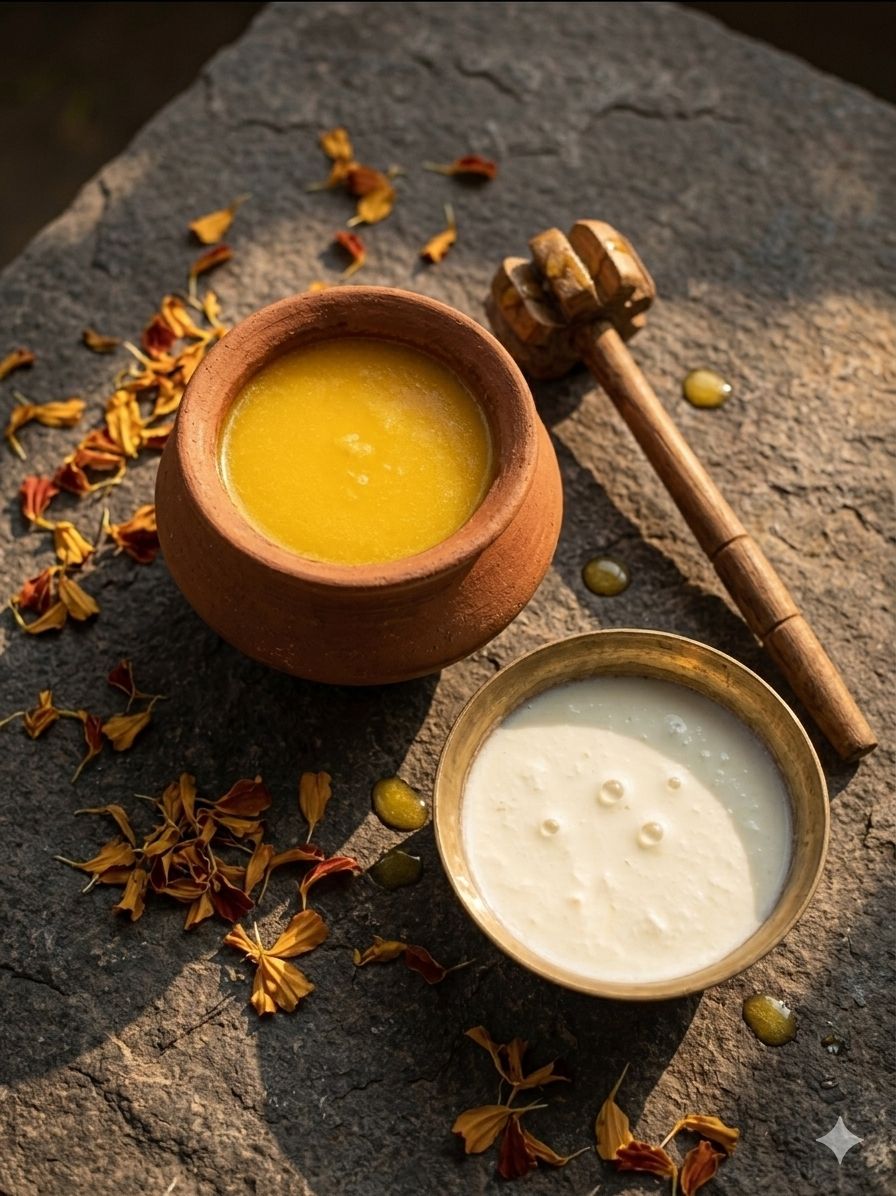
The Bilona Method: Why Your Grandmother's Ghee Was Different From Everything You Buy Today
Published by YugaFarms · June 2026 · 9 min read
There's a reason ghee made at home 40 years ago tasted nothing like the jar you pick up at a supermarket today.
It wasn't nostalgia. It wasn't the magic of childhood. It was the process.
Most people have no idea how commercial ghee is actually made — or how radically different it is from the traditional method that Indian households followed for thousands of years. Once you understand the difference, you won't look at a ghee label the same way again.
What Is the Bilona Method, Exactly?
The word bilona comes from the Sanskrit root meaning "to churn." But it's not just about churning — it's about the sequence of steps, each one protecting the nutritional integrity of the final product.
Here's how it works, step by step:
Step 1 — Fresh A2 Milk It starts with whole, full-fat milk from desi A2 cows — breeds like Sahiwal, Gir, or Rathi. Not hybrid cows. Not buffalo. The A2 protein structure is fundamentally different, and it matters for everything that follows.
Step 2 — Setting Curd The milk is gently heated and then cooled to the right temperature before a small amount of natural starter (jaman) is added. The milk is left overnight to set into thick, full-fat curd. No shortcuts, no additives.
Step 3 — Hand Churning This is the step that makes bilona ghee what it is. The curd is churned — traditionally using a wooden hand churner called a mathani, moved in alternating directions — until the fat separates as white butter. The alternating motion matters. It creates a butter that retains the curd's natural probiotic qualities and fat structure.
*Hand churning is done early in the morning with sunrise so that positive energy can be added. *
Step 4 — Washing the Butter The freshly churned butter is washed with cold water to remove residual buttermilk. What remains is called bilona makkhan — a soft, ivory-white butter that smells faintly of curd.
Step 5 — Slow Cooking on Low Flame The butter is melted slowly over a low flame — never rushed, never boiled aggressively. As the water evaporates and milk solids separate and settle to the bottom, the ghee clarifies. The moment it turns golden and the solids turn light brown is the moment it's done.
The entire process, from milk to ghee, takes 2–3 days.
How Commercial Ghee is Made (And Why It's Different)
Commercial ghee skips most of this.
Instead of curd → churned butter → slow-cooked ghee, the industrial process uses cream separated directly from milk using centrifuges. That cream is then converted into butter using mechanical churning, and the butter is rapidly heated at high temperatures to make ghee at scale.
No curd. No hand churning. No slow flame.
The result looks like ghee. It smells roughly like ghee. But the nutritional profile is not the same.
Here's what gets lost:
- Conjugated Linoleic Acid (CLA) — naturally present in full-fat curd, partially destroyed by industrial processing
- Fat-soluble vitamins — heat-sensitive; high-temperature processing reduces their bioavailability
- Butyric acid — the short-chain fatty acid responsible for gut lining repair; present in higher concentrations in traditionally churned ghee
- The probiotic pathway — because bilona starts from curd, the fat carries trace compounds that cream-based butter simply doesn't have
Our ghee is lab tested so that we can assure with numbers also --- Lab Reports
The Buttermilk That's Left Behind
One thing most people don't know: when you churn curd the bilona way, the leftover liquid is chaas — traditional buttermilk.
This isn't the thin, watery liquid left over from cream processing. This is the real thing — slightly sour, alive with natural probiotics, rich in protein. For every kilogram of bilona ghee, roughly 20–25 litres of curd is churned. The chaas that remains is a byproduct that was traditionally given to family, farm workers, or consumed daily as a digestive.
This ratio also tells you why bilona ghee costs more. There's no shortcut that produces it at the same yield as industrial methods.
Why the Cow Breed Is Not a Footnote
You'll notice that bilona ghee is almost always made specifically from A2 desi cow milk — not A1 hybrid breeds, not buffalo.
This isn't marketing. The A2 beta-casein protein in desi cow milk digests differently in the human body compared to the A1 variant found in most hybrid breeds. A1 protein breaks down into a peptide called BCM-7 during digestion, which some studies associate with digestive discomfort in sensitive individuals. A2 milk skips this pathway entirely.
When the starting material is A2 milk, and it's processed through traditional bilona churning, the final ghee carries a different fat composition — more structured, more bioavailable, easier on the digestive system.
[We chose to work exclusively with the indigenous Sahiwal cow because she is not just a breed—she is the eternal mother of our soil. For thousands of years, her life-giving A2 milk has nourished and sustained the families of the Northern region. By bringing back her sacred gift, we aren’t just creating ghee; we are honoring a millennia-old legacy of pure, ancestral wellness.]
What Bilona Ghee Looks, Smells, and Tastes Like
This matters — because if you've only ever had commercial ghee, you might be surprised the first time.
Colour: Bilona ghee is typically a deeper, more golden yellow — sometimes with a slight greenish tint depending on the season and what the cows have been eating. It is not pale yellow like most commercial ghee.
Texture: At room temperature (below 25°C), it's semi-solid with a slightly grainy, crystalline texture. This granularity is a sign of quality — it indicates slow cooling and a higher concentration of short-chain fatty acids.
Smell: Rich, nutty, and slightly earthy — not the flat, buttery smell of commercial ghee. Some people describe it as smelling like roasted caramel or warm cream. It's noticeable even before the jar is fully open.
Taste: The first thing most people notice is the depth — it's not just "fat," it has layers. A faint nuttiness, a mild sweetness, and a clean finish. When used for tadka, it has a fragrance that spreads through the entire kitchen.
A Note on "Bilona Ghee" Labels in the Market
Since bilona ghee started gaining mainstream attention, a number of brands have begun labelling their products as "bilona" or "hand-churned" without actually following the traditional process.
What to look for when buying:
- Starts from curd, not cream — ask the brand directly
- A2 desi cow milk — not A1 hybrid, not mixed breed
- Slow cooking on low flame — not industrial heat processing
- Small batch production — large-scale factories cannot do bilona correctly
- Lab reports — any serious producer should have third-party testing available
The Honest Summary
The bilona method isn't a marketing term. It's a specific, labour-intensive process that produces a ghee with a meaningfully different nutritional profile from what most people are buying.
It takes more time. It uses more milk per kilogram of output. It can't be scaled without losing what makes it what it is.
That's why it costs more. And that's exactly why it's worth it.
Made at YugaFarms using A2 Sahiwal cow milk, traditional bilona churning, and slow cooking on a wood fire. [Lab reports available at yugafarms.com/lab-reports]
You might also like: