
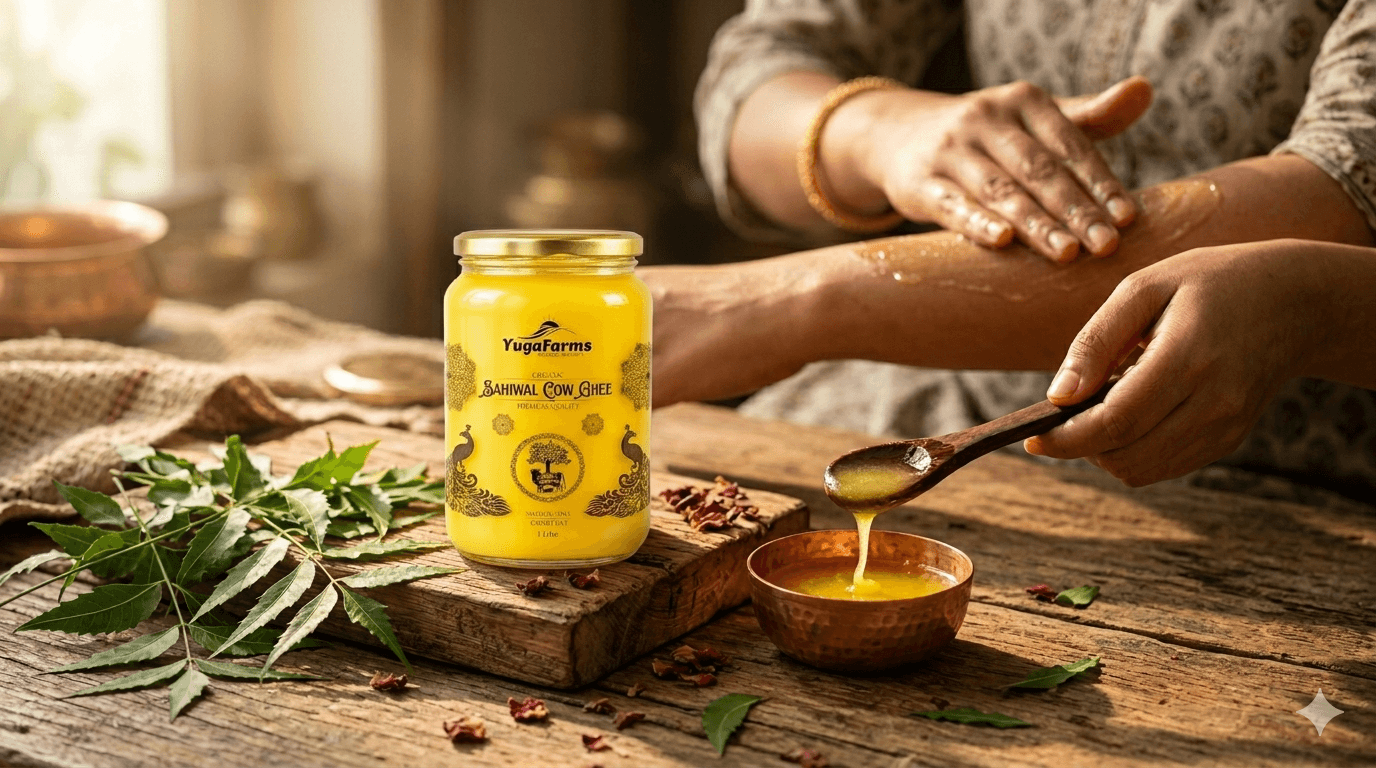
A2 Bilona Ghee for Skin and Hair: The Ancient Beauty Secret That Actually Works
Your grandmother never needed a 12-step skincare routine. She had one jar of ghee and knew exactly what to do with it.
There's a reason Indian brides have been massaged with ghee for thousands of years before their weddings. There's a reason your nani applied it to cracked heels every winter without fail. There's a reason Ayurvedic texts describe ghee as the most complete food for the body — inside and out.
Modern skincare brands have discovered ingredients like ceramides, squalane, and butyric acid — then sold them back to us at ₹2,000 a bottle. Ghee contains all of them, naturally, in a form your skin has evolved to absorb.
But not all ghee works equally on skin and hair. The difference between regular commercial ghee and genuine A2 Bilona Ghee is the difference between a processed product and a living food — and your skin notices.
This blog covers everything: what makes A2 Bilona Ghee uniquely effective for skin and hair, how to use it for specific concerns, and the science behind why something this old still works better than most of what's in your bathroom cabinet.
Why A2 Bilona Ghee Is Different from Regular Ghee for Skin
To understand why this matters, it helps to understand what's actually in the ghee.
A2 Bilona Ghee is made using the traditional curd-churning method — milk from indigenous Indian cows (like Sahiwal or Gir) is first cultured into curd overnight, churned by hand at dawn, and the resulting butter is slow-cooked over a wood flame into ghee. This is the opposite of the industrial cream-separation method used for most commercial ghee.
This process matters for skin and hair because:
It retains fat-soluble vitamins. Vitamins A, D, E, and K2 survive the bilona process in meaningful quantities. Industrial ghee processing at high temperatures destroys much of this. Vitamin A is the foundation of skin cell turnover. Vitamin E is a potent antioxidant that slows skin ageing. Vitamin D supports skin barrier function. You cannot replace these from a synthetic cream.
It preserves CLA and butyric acid. Conjugated Linoleic Acid (CLA) has anti-inflammatory properties that matter for conditions like eczema, psoriasis, and dry skin flares. Butyric acid isn't just a gut nutrient — it reduces skin inflammation when applied topically, which is why many modern skincare formulas now include synthetic butyric acid derivatives. Authentic A2 Bilona Ghee has it naturally.
The fat profile mirrors human sebum. The fatty acid composition of desi cow ghee — particularly the ratio of saturated and unsaturated fats — is closer to the skin's own natural oils than most plant-based alternatives. This is why ghee absorbs into skin without the greasiness that coconut oil or almond oil can sometimes leave.
It's free of added emulsifiers, preservatives, and fragrances. These are the hidden culprits behind many skin reactions. Pure A2 Bilona Ghee contains one ingredient: ghee.
Ghee for Skin: What It Actually Does
1. Deep Moisturisation for Dry and Dehydrated Skin
Dry skin isn't just uncomfortable — it's a sign of a compromised skin barrier. When the barrier breaks down, moisture escapes, irritants enter, and the cycle of dryness, inflammation, and sensitivity begins.
Ghee works on dry skin by doing two things simultaneously: adding lipids (fats) back to the skin surface, and reducing the inflammation that keeps the barrier from healing. Vitamin A accelerates cell turnover, bringing fresh, healthy cells to the surface faster. Vitamin E seals moisture in.
How to use it: Warm a small amount between your fingertips and apply to clean, slightly damp skin on the face or body. A tiny amount goes a long way — you want a thin film, not a thick layer. Apply at night for best results; the skin repairs itself during sleep and benefits most from this kind of nourishment in the overnight hours.
2. Cracked Heels and Dry Elbows
Cracked heels are one of the most stubbornly persistent skin problems. The heel tissue is thick, constantly under pressure, and the area has fewer oil glands than the rest of the body — which means it dries out faster and cracks more readily, especially in winter.
Ghee is one of the oldest and most effective treatments for this. The combination of vitamins A and E, combined with the fat's ability to penetrate thick callused skin over time, produces results that petroleum-based products simply cannot match.
How to use it: At bedtime, apply a generous amount of A2 Bilona Ghee to clean, dry heels. Cover with clean cotton socks and sleep. Repeat for five to seven consecutive nights. For mild cracking, three nights is often enough. For severe cracks that have been neglected for months, give it two weeks.
The same method works for extremely dry, cracked elbows and knuckles in winter.
3. Under-Eye Area and Fine Lines
The skin around the eyes is the thinnest on the body — typically around 0.5mm compared to 2mm elsewhere. It loses moisture quickly, shows fatigue readily, and is the first place where fine lines appear.
Commercial under-eye creams often contain retinol (synthetic Vitamin A), peptides, and hyaluronic acid. A2 Bilona Ghee provides natural Vitamin A, which the skin converts to retinol as needed, plus the fatty acids that help skin retain moisture and maintain elasticity.
How to use it: Using your ring finger (which applies the least pressure), dab a tiny amount of A2 Bilona Ghee under each eye before bed. Do not rub. Let it absorb. A pea-sized amount is enough for both eyes.
Start slowly — some people with very sensitive skin experience mild initial breakouts as ghee accelerates cell turnover. If this happens, reduce frequency to every other night until skin adjusts.
4. Chapped and Dry Lips
Petroleum-based lip balms create the illusion of moisture by sealing the surface — but they don't actually hydrate or nourish. Ghee does both.
How to use it: Apply a tiny amount to lips before bed. It absorbs overnight and leaves lips noticeably softer by morning. For extremely chapped lips, do this for three consecutive nights.
5. Mild Eczema and Sensitive Skin
Eczema (atopic dermatitis) is characterised by skin barrier dysfunction, chronic inflammation, and hypersensitivity to irritants. The anti-inflammatory fatty acids in A2 Bilona Ghee — particularly CLA and Omega-3s — can help calm flares when applied topically.
Important: Ghee is not a medical treatment for eczema. If you have a diagnosed condition, consult your dermatologist. But for mild, occasional skin sensitivity and irritation, ghee applied to affected areas has a strong traditional track record and a sound biochemical basis.
Ghee for Hair: What It Actually Does
1. Scalp Nourishment and Dandruff
Most dandruff is caused by one of two things: a dry, flaky scalp (seborrheic dermatitis) or a fungal overgrowth (malassezia). Ghee addresses the first cause directly — by restoring the lipid layer on the scalp that keeps skin cells healthy and intact.
The butyric acid in A2 Bilona Ghee has documented anti-inflammatory properties that help reduce the scalp inflammation that drives chronic dandruff. Regular oiling with ghee also creates an environment less hospitable to fungal overgrowth by normalising the scalp's oil balance.
How to use it: Warm A2 Bilona Ghee gently (just to liquid, not hot). Apply directly to the scalp with fingertips and massage in slow circular motions for 5–10 minutes. Focus on areas with flaking or irritation. Leave for 45 minutes to an hour, then wash out with a mild shampoo. Do this once a week.
Don't skip the massage — scalp stimulation increases circulation to hair follicles, which supports stronger growth and reduces hair fall over time.
2. Dry, Brittle, and Frizzy Hair
Highly processed hair — bleached, coloured, heat-styled, or simply exposed to hard water and pollution — loses its natural lipid coating. The result is dryness, frizz, breakage, and lack of shine.
A2 Bilona Ghee replenishes this lipid coating at the hair shaft level. The fatty acids fill gaps in the cuticle (the outermost layer of each hair strand), smoothing the surface and reducing moisture loss. This is what reduces frizz and restores shine — not by coating the hair with a synthetic film, but by genuinely restoring what's missing.
How to use it: Warm a small amount of ghee and apply to the hair length (not roots) about 30 minutes before washing. Comb through with a wide-tooth comb to distribute evenly. Wrap in a warm towel or shower cap, then wash out. Do this before every wash, or at least once a week for severely damaged hair.
For very dry ends, a tiny amount of ghee applied to towel-dried ends after washing — like a hair serum — works as a leave-in treatment.
3. Hair Fall and Thinning
Hair fall has many causes — stress, nutritional deficiency, hormonal imbalance, and scalp health are the most common. Ghee addresses scalp health directly. A nourished scalp with good circulation and reduced inflammation retains hair better than a dry, inflamed one.
The fat-soluble vitamins in A2 Bilona Ghee — particularly Vitamin A (cell turnover) and Vitamin E (antioxidant, circulation) — support the environment in which hair follicles grow. They cannot reverse severe hormonal or genetic hair loss, but for hair fall driven by scalp neglect and poor nourishment, regular ghee oiling makes a meaningful difference.
How to use it: Weekly scalp massage with warm A2 Bilona Ghee as described above. Consistency over months matters more than frequency in a single week.
4. Deep Conditioning Pre-Wash Treatment
For hair that needs intensive conditioning — whether from over-processing, seasonal dryness, or neglect — an overnight ghee treatment is one of the most effective options available.
How to use it: Apply warm ghee generously from scalp to tips before bed. Cover with a shower cap or old cloth to protect your pillow. Wash out thoroughly in the morning. The extended contact time allows the fatty acids to penetrate deeper into the hair shaft than a short pre-wash treatment can achieve.
Do this once a month for maintenance, or once a week for two to three weeks if your hair is severely damaged.
A Note on What "A2 Bilona" Actually Means for Skin
When you're buying ghee for topical use, the source matters more than for any other application. You're putting this directly on your skin — sometimes near your eyes, on broken skin, in your child's scalp.
Regular commercial ghee often contains residual traces of the cream-separation process and is made from mixed milk sources without breed verification. For dietary use, this is a quality concern. For topical use, it's also a purity concern.
Genuine A2 Bilona Ghee, made from the milk of a single identified desi cow breed using the curd-churning method, is as close to pure milk fat as you can get. No additives, no emulsifiers, no preservatives. This is what your skin is actually benefiting from.
If you're not sure whether the ghee you have is authentic, our detailed guide — How to Identify Real A2 Bilona Ghee: 6 Tests You Can Do at Home — will walk you through exactly what to look for before putting it on your skin.
How Does It Compare to Other Oils?
This question comes up often, so here's a direct comparison:
Ghee vs Coconut Oil: Coconut oil is antifungal and absorbs reasonably well, but its fatty acid profile is very different from skin sebum. It can clog pores in some people. Ghee is less likely to cause congestion and provides fat-soluble vitamins that coconut oil lacks.
Ghee vs Almond Oil: Almond oil is light and pleasant but lacks the butyric acid and Vitamin K2 found in ghee. For dry skin, ghee is more intensively nourishing.
Ghee vs Commercial Moisturisers: Most commercial moisturisers are primarily water with emulsifiers, preservatives, and synthetic actives to hold it all together. Ghee is 100% bioavailable fat with naturally occurring vitamins. They serve different purposes — a moisturiser sits on the surface; ghee penetrates and feeds.
Ghee vs Castor Oil: Castor oil is excellent for hair growth in specific applications (edges, eyebrows) due to its ricinoleic acid content. For general scalp and hair nourishment, ghee is more versatile and easier to wash out.
What to Expect: A Realistic Timeline
Skin and hair respond to consistent nourishment, not dramatic single interventions. Here's what a realistic timeline looks like:
Week 1–2: Improved texture on dry areas (heels, elbows, lips). Slight improvement in hair softness after washing.
Week 3–4: Scalp flaking begins to reduce with weekly oiling. Skin feels noticeably more supple and less reactive to seasonal changes.
Month 2–3: Hair shine improves, breakage reduces. Under-eye area appears more hydrated. Chronic dry skin conditions begin to stabilise.
Month 4+: Where the traditional results show up. Consistent users report softer skin overall, stronger hair with less fall, and a general improvement in how the skin handles stress and seasonal changes.
None of this happens overnight. It happens the same way all meaningful body changes happen — through small, repeated actions sustained over time.
The Internal Connection: What You Eat Matters Too
Here's something most beauty guides don't tell you: the condition of your skin and hair reflects your gut health more than anything you put on them.
A2 Bilona Ghee consumed daily — one teaspoon on an empty stomach, ghee in your cooking — supports the gut lining through butyric acid, reduces systemic inflammation through CLA and Omega-3s, and delivers fat-soluble vitamins that reach the skin from the inside. The external applications described above work best when the body is also being nourished internally.
This is exactly why Ayurveda never separated internal and external use. Ghee was always both. Read our guide on how to use A2 Bilona Ghee every day — internally and externally — to understand the complete daily practice.
And if you're concerned about whether consuming ghee will affect your weight, we cover that directly and honestly in our post: Does A2 Bilona Ghee Help with Weight Loss?
Practical Storage Note
A2 Bilona Ghee used for skin and hair should be stored the same way as ghee for cooking — in a clean, dry glass jar, away from moisture and direct sunlight. Keep a dedicated small jar for topical use if you prefer, so you're not cross-contaminating your cooking ghee with wet hands.
No refrigeration required. Shelf life of 12 months or more when stored correctly with a dry spoon.
The Bottom Line
Your grandmother's beauty routine wasn't primitive. It was precise. She used A2 Bilona Ghee on her skin and hair because it worked — not despite the lack of science to explain it, but because thousands of years of observation had shown her exactly how and when and how much.
Modern science has now caught up with most of it. The vitamins, the fatty acids, the anti-inflammatory compounds, the skin-barrier support — it's all there in the research.
What's changed is that getting genuine A2 Bilona Ghee is harder than it used to be, in a market full of products wearing the label without earning it. That's the only problem worth solving — and it's solvable.
At Yuga Farms, our A2 Bilona Ghee is made from the milk of Sahiwal cows in Palwal, Haryana — hand-churned, slow-cooked, lab-tested, and shipped directly to your door. The same ghee your skin has always needed.
Questions? Reach us at support@yugafarms.com or call +91 96710 12177.
Published by Yuga Farms | Janouli, Palwal, Haryana | yugafarms.com