
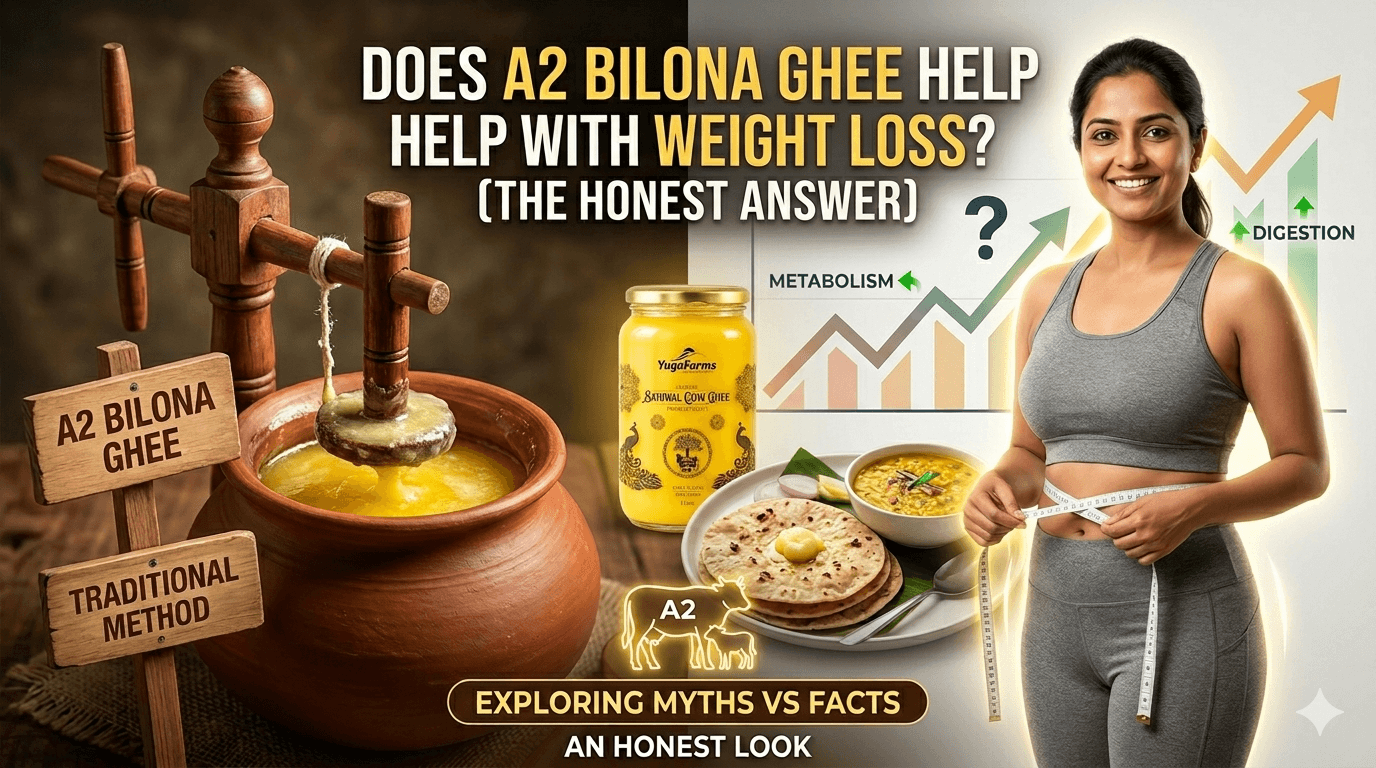
Does A2 Bilona Ghee Help with Weight Loss? (Here's the Honest Answer)
Everyone told you ghee makes you fat. Here's what the science — and thousands of years of Ayurvedic wisdom — actually say.
There's a conversation that happens almost every week in Indian households.
Someone decides to eat healthier. They start cutting things out. Sugar. Fried food. White rice. And then, almost always, ghee.
Because ghee is fat. And fat makes you fat. Right?
If you've grown up in the last three decades of Indian nutrition advice, that's probably what you were told. But if you've recently started hearing about A2 Bilona Ghee and weight loss in the same sentence and thought — wait, how does that work? — this blog is for you.
We're going to give you the honest, full picture. Not just the enthusiastic "ghee burns fat!" headlines, and not the reflexive "ghee is unhealthy!" dismissal either. Just what we know, what the evidence suggests, and what you should actually do.
First: Why Did We Ever Think Ghee Was the Enemy?
To understand why A2 Bilona Ghee is worth reconsidering, it helps to understand why ghee got demonised in the first place.
In the 1960s and 70s, a large body of nutritional research — much of it later found to be flawed or industry-influenced — concluded that dietary fat, especially saturated fat, caused heart disease and obesity. The logical response was: cut fat from your diet.
Ghee is almost entirely fat. So out it went.
The problem? The low-fat dietary revolution that followed didn't make people healthier. Obesity rates climbed anyway, largely because when fat was removed from food, it was replaced with refined carbohydrates and sugar — which turned out to be far more problematic for weight and metabolic health.
In the decades since, nutritional science has significantly revised its position on dietary fats. Not all fats are equal. Not all saturated fats behave the same way in the body. And the quality and source of the fat matters enormously — which is exactly where A2 Bilona Ghee enters the picture.
What Makes A2 Bilona Ghee Different from Regular Fat?
Before we talk about weight, it's worth being clear about what A2 Bilona Ghee actually is — because it is genuinely different from regular ghee, refined oil, or butter.
A2 refers to the type of milk protein (beta-casein) found in milk from indigenous Indian cow breeds like Sahiwal, Gir, and Tharparkar. Regular commercial dairy often uses A1 milk from crossbred cattle. A2 milk is considered easier to digest and less inflammatory for many people.
Bilona refers to the traditional hand-churning process. The milk is first cultured into curd, then the curd is churned with a wooden churner (bilona) to extract butter, and that butter is slow-cooked into ghee. This is the opposite of how commercial ghee is made — from cream, not curd — and the process preserves nutrients that are lost in industrial methods.
The result is a ghee that contains:
- Conjugated Linoleic Acid (CLA) — a naturally occurring fatty acid found in dairy from grass-fed and pasture-raised cows, associated with reduced body fat in several studies
- Butyric acid — a short-chain fatty acid that feeds the cells lining your gut, supports a healthy microbiome, and has been linked to better metabolic function
- Fat-soluble vitamins — A, D, E, and K2, which are absorbed efficiently because they're suspended in fat
- Omega-3 and Omega-9 fatty acids — in better ratios than most processed cooking oils
None of these are present in refined vegetable oils. And they're present in much lower quantities in commercially produced ghee.
So Does A2 Bilona Ghee Actually Help with Weight Loss?
Let's be direct: A2 Bilona Ghee is not a weight loss product. It won't melt fat while you sit still. No food does.
But here's what it can do — and why these things matter more than most people realise:
1. It Supports a Healthier Gut — and Your Gut Runs Your Metabolism
The butyric acid in A2 Bilona Ghee is food for your gut's epithelial cells. A well-functioning gut lining means better nutrient absorption, less inflammation, and — critically — a healthier gut microbiome.
Your gut bacteria influence almost everything: your cravings, your energy levels, how efficiently you absorb calories, and even your mood. An inflamed or "leaky" gut is increasingly recognised as a contributor to weight gain and metabolic disorders. Ghee, particularly A2 Bilona Ghee, is one of the most ancient and effective foods for healing and maintaining the gut lining.
When your gut works better, your metabolism tends to follow.
2. CLA Has Been Linked to Reduced Body Fat
Conjugated Linoleic Acid (CLA) is present in meaningful amounts in ghee from pasture-raised, traditionally cared-for cows — exactly the kind used for A2 Bilona Ghee.
Multiple studies have found that CLA supplementation is associated with reductions in body fat mass, particularly abdominal fat. The mechanism is still being studied, but CLA appears to influence how the body uses and stores fat at a cellular level.
This doesn't mean eating ghee is equivalent to taking a CLA supplement. The amounts differ. But it does mean that the fat in A2 Bilona Ghee is not metabolically inert — it has a biological effect that regular refined oil simply doesn't.
3. Fat Slows Sugar Absorption — Reducing Spikes and Crashes
One of the most underappreciated effects of eating good fats with carbohydrates is that the fat slows down how quickly glucose enters your bloodstream.
When you eat plain roti, rice, or dal without any fat, the carbohydrates digest quickly, causing a sharper spike in blood sugar — followed by a crash that leaves you hungry again within a couple of hours. Adding a small amount of A2 Bilona Ghee to the same meal changes the glycaemic response. The food digests more slowly, the blood sugar rise is more gradual, and you feel satisfied for longer.
Fewer blood sugar crashes = fewer cravings = less unnecessary eating. Over time, this adds up significantly.
4. Ghee Satisfies — Which Means You Eat Less Overall
Fat is the most satiating macronutrient. A small amount of A2 Bilona Ghee in a meal triggers the release of satiety hormones that signal your brain: enough.
People who remove all fat from their diet in an attempt to lose weight often find themselves hungry constantly, snacking compulsively, and struggling to sustain any eating pattern. Adding a moderate amount of high-quality fat — like A2 Bilona Ghee — can actually make it easier to eat less, not harder.
The Ayurvedic View: Ghee Was Never the Problem
In Ayurveda, ghee (called ghrita) has been considered a cornerstone of health for thousands of years. Crucially, it was never associated with weight gain when used properly. Ayurvedic texts recommend:
- One teaspoon on an empty stomach in the morning — to kindle agni (digestive fire) and protect the gut
- Adding ghee to cooked food — to improve digestion and nutrient absorption
- Using ghee in moderation — the quantity matters; ancient texts did not recommend eating ghee by the cup
The distinction Ayurveda makes is between ama (undigested toxins that cause weight gain and disease) and ojas (vital nourishment that supports health). Good ghee, properly used, was considered deeply nourishing — building ojas, not ama.
The modern equivalent of this distinction is roughly: quality of food matters more than simply counting fat grams.
What You Should Actually Do
Here's a practical approach, grounded in both traditional wisdom and modern understanding:
Start with one teaspoon every morning on an empty stomach. This is the most commonly recommended Ayurvedic practice and a low-effort way to begin experiencing the gut benefits.
Add ghee to cooked meals, not raw food. A2 Bilona Ghee works best when it's added to warm food — tadka, roti, khichdi, rice, dal. It blends into the food and its fat-soluble compounds become bioavailable.
Use it instead of refined oil, not in addition to everything else. This is important. If your goal is weight management, swapping refined vegetable oil for A2 Bilona Ghee makes sense. Adding ghee on top of an already high-calorie diet does not.
Keep quantities reasonable. One to two teaspoons per meal is a sensible amount for most adults. More is not automatically better.
Give it time. The gut healing effects of butyric acid, the metabolic benefits of CLA, the improved digestion — none of these show up in a week. Commit to three to four weeks of consistent use before evaluating how you feel.
A Note on What We See at Yuga Farms
We hear from our customers regularly. And a pattern has emerged over the past couple of years.
People who switch to A2 Bilona Ghee and use it consistently — one spoon in the morning, ghee in their cooking, reasonable quantities — often report feeling lighter, not heavier. Less bloating. Better digestion. More stable energy throughout the day. And over months, some report gradual, sustainable weight loss — not dramatic, but real.
We can't make clinical claims about ghee and weight loss. But we do believe that when you nourish your gut, stabilise your blood sugar, reduce inflammation, and eat satisfying, wholesome food — weight tends to follow in the right direction.
A2 Bilona Ghee doesn't work against your health goals. When used thoughtfully, it works with them.
The Bottom Line
Ghee — specifically A2 Bilona Ghee made by the traditional bilona process — is not the enemy of weight management. The fear of ghee was built on oversimplified nutritional science from half a century ago.
What actually helps with weight: eating real food, maintaining stable blood sugar, supporting gut health, reducing inflammation, and feeling satisfied enough that you don't overeat. A2 Bilona Ghee, used in the right amounts, supports all of these.
So don't cut the ghee. Cut the refined oil. Switch to something your great-grandmother would have recognised. And give your body time to respond.
At Yuga Farms, our A2 Bilona Ghee is made from the milk of Sahiwal cows using the traditional bilona hand-churning process — the same way it's been made in Indian homes for generations. Lab-tested, farm-fresh, and shipped directly to your door.