
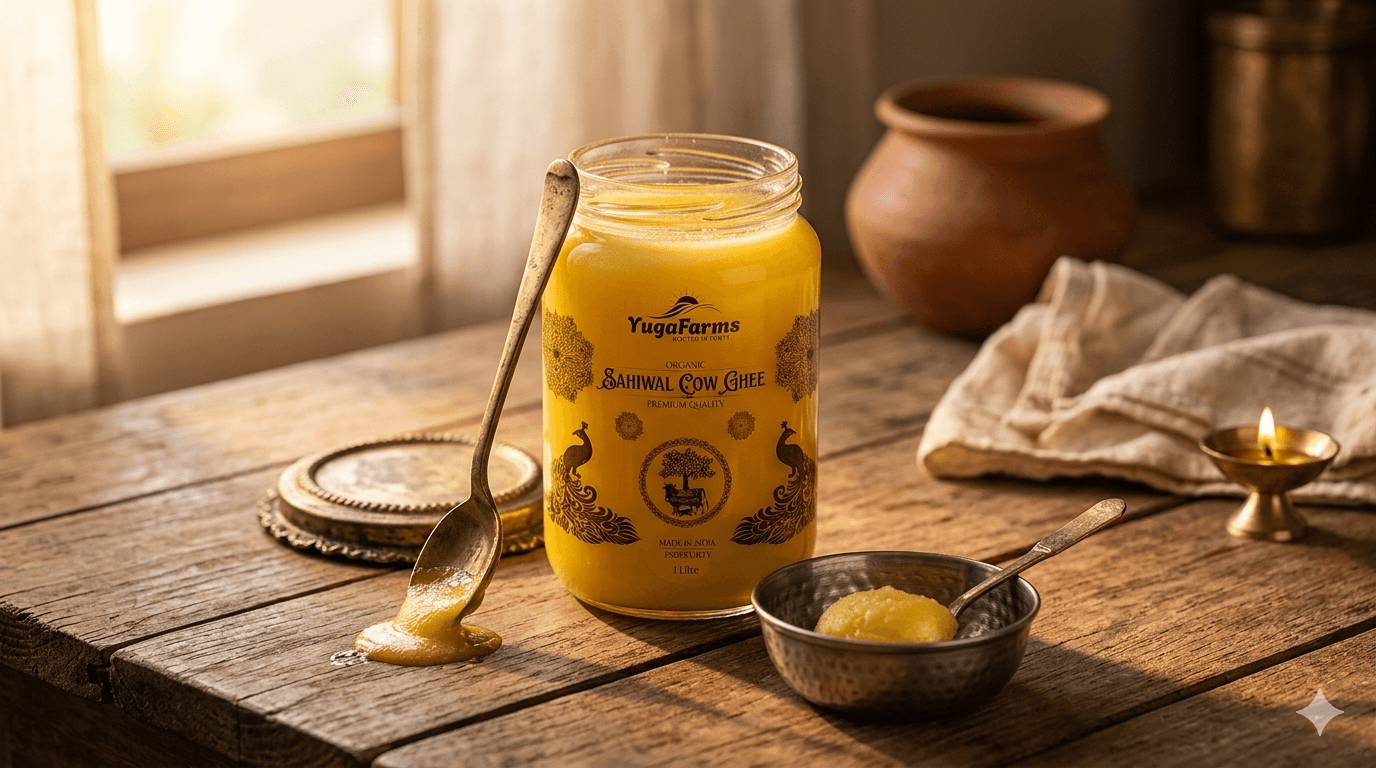
How to Use A2 Bilona Ghee Every Day (And Actually Feel the Difference)
Most people who switch to A2 Bilona Ghee use it exactly the same way they used regular ghee — a small spoon on dal, maybe a drizzle on roti. That's fine. But you're probably leaving a lot on the table. Here's how to get the most out of every jar.
There's a pattern we've noticed with people who order from us at Yuga Farms.
They try A2 Bilona Ghee for the first time. They notice the smell — that warm, nutty, almost nostalgic aroma. They taste it. Something clicks. They order again. And then they start asking: what else can I do with this?
This blog is the answer to that question.
We're going to cover the best ways to use A2 Bilona Ghee daily — in cooking, in wellness routines, on your skin, and in the small rituals that actually make a difference over time. Along the way, we'll explain why each use works, because understanding the "why" is what turns a healthy habit into something you actually stick with.
Before Anything Else: Start Your Morning with One Spoon
This is the most underrated habit in the entire list, so it goes first.
Take one small teaspoon of A2 Bilona Ghee on an empty stomach, first thing in the morning. That's it. Just let it melt on your tongue and swallow.
Sounds too simple to matter. But this practice comes directly from Ayurveda, and there's good reason it's survived thousands of years of dietary advice.
Ghee consumed on an empty stomach coats and protects the stomach lining before food arrives. The butyric acid in pure ghee feeds the cells lining your gut, helping maintain the intestinal barrier that keeps your digestion running smoothly. People who do this consistently — over weeks, not days — often report less bloating, easier digestion, and more stable energy in the mornings.
It also helps with appetite regulation. A small amount of fat first thing in the morning can reduce the sugar cravings that hit mid-morning and derail the rest of your day.
One spoon. Every morning. Give it three weeks before you judge it.
In the Kitchen: Where A2 Bilona Ghee Actually Belongs
Use It for Tadka — Not Oil
This is the single most impactful cooking swap you can make.
The tadka — that moment when whole spices hit a hot fat and release their flavour into your dal, sabzi, or khichdi — defines the taste of Indian cooking more than almost any other step. Most people use refined oil or even regular ghee for this. Switching to A2 Bilona Ghee changes the entire character of the dish.
Because bilona ghee has a genuinely high smoke point (around 250°C), it handles high-heat tadka without breaking down. But more importantly, the fat-soluble compounds in A2 ghee act as a carrier for the volatile flavour molecules in spices like jeera, mustard, and dried red chilli. The spices bloom differently — more deeply, more completely — when they're hitting good ghee rather than neutral oil.
The difference in taste is not subtle. Try it once and you'll understand why people used to eat dal-chawal every day without getting bored.
Add It to Khichdi and Rice — While Hot
There's a reason khichdi with ghee is the go-to Indian comfort food. The combination of easily digestible rice and lentils plus the butyric acid and healthy fats in ghee is genuinely soothing to the gut. It's what you eat when you're ill, recovering, or just need something light.
Add your ghee to the khichdi or rice immediately after cooking, while the food is still steaming hot. The heat helps the ghee distribute evenly and melt into every grain. Don't refrigerate the food first and then add ghee — you lose both the flavour and some of the effect.
Use It Instead of Butter for Rotis and Parathas
This one is straightforward. A2 Bilona Ghee on a fresh roti straight off the tawa is one of the best things in Indian food. The fat in ghee also slows down the digestion of the roti's carbohydrates — meaning you get more stable energy and less of a blood sugar spike compared to eating plain bread.
For parathas, cooking them in A2 Bilona Ghee instead of regular oil produces a noticeably richer flavour and a slightly crisper texture. Yes, it costs more per roti. It's worth it.
Elevate Your Eggs
If you make eggs in the morning — scrambled, fried, or omelette — try cooking them in a small knob of A2 Bilona Ghee instead of oil or butter.
The eggs become noticeably richer and creamier. The ghee adds a slight nuttiness that pairs well with pepper and salt. And you're starting your day with a combination of good fat and protein that keeps you full well into the afternoon.
For Halwa, Ladoo, and Mithai — Don't Compromise
Indian sweets made with pure ghee are completely different from those made with vanaspati or refined oil. The aroma alone during the cooking process is worth it — your house will smell the way your grandmother's did when she made halwa during festivals.
For gajar halwa, besan ladoo, or suji halwa: use A2 Bilona Ghee generously. These sweets are already occasional treats, so when you make them, make them properly. The flavour is incomparable.
Beyond Cooking: The Daily Wellness Uses
Nasya — Ghee in the Nostrils
This one sounds strange to modern ears but it's one of the most established Ayurvedic practices, called nasya.
Two to four drops of warm, liquefied A2 Bilona Ghee in each nostril, first thing in the morning, before brushing your teeth.
The nasal passages are the gateway to the brain, sinuses, and respiratory system. Ghee applied this way is said to lubricate the membranes, protect against dust and pollutants, and support clearer breathing. People who live in dusty or polluted environments (which is most of urban and semi-urban India) find this particularly useful.
Warm the ghee gently — just to liquid, not hot — lie down, tilt your head back slightly, and apply two drops per nostril. Breathe in slowly. Rest for a minute.
The first few times feel odd. After a week, it starts to feel like something you'd miss if you skipped it.
Ghee and Warm Milk at Night
A cup of warm milk with half a teaspoon of A2 Bilona Ghee before bed is an old Indian remedy for sleep and joint health. The combination of tryptophan (in milk) and fat (in ghee) has a genuinely calming effect. It's also traditionally recommended for joint lubrication — the healthy fats in ghee are believed to support the body's natural oil mechanisms.
It's not a dramatic intervention. It's the kind of slow, consistent practice that pays off over months rather than days.
Ghee with Warm Water for Constipation
A teaspoon of A2 Bilona Ghee stirred into a glass of warm water, consumed first thing in the morning, is a traditional Ayurvedic remedy for constipation and sluggish digestion. The butyric acid in ghee gently stimulates gut motility, and the fat helps lubricate the intestinal walls.
This is one of those remedies that sounds too simple but works for a lot of people. If you have chronic constipation or hard stools, try this for two weeks before reaching for a laxative.
On the Skin and Hair: The External Uses
A2 Bilona Ghee has been used as a topical application in India for centuries. The fat structure is close enough to the skin's natural sebum that it absorbs without leaving the same residue that heavier oils do.
Dry Skin and Cracked Heels
Ghee applied to very dry skin — elbows, knees, cracked heels — overnight under cotton socks or gloves works remarkably well. The vitamin A and E content helps with skin barrier repair, and the fat absorbs over the hours while you sleep.
It's not elegant. But if you have badly cracked heels going into winter, try this for five nights in a row and see what happens.
Chapped Lips
A tiny amount of A2 Bilona Ghee on chapped lips works better than most petroleum-based lip balms because it actually nourishes rather than just sealing moisture in. Apply before bed.
Hair and Scalp Oil (The Old Way)
Warm a small amount of A2 Bilona Ghee and massage it into the scalp before washing your hair. Leave for 30–45 minutes, then wash out normally. It conditions the scalp, can help with dryness and mild dandruff, and leaves the hair with a natural sheen.
This is especially useful in winter when both scalp and hair tend to dry out. The vitamins in pure, curd-based ghee are better retained than in processed oils, which is why it works where commercial hair oils sometimes don't.
How Much A2 Bilona Ghee Should You Use Daily?
A common concern: is ghee fattening? Should I limit it?
The honest answer: ghee is a fat, so calories matter. But the type of fat in A2 Bilona Ghee — including short-chain fatty acids like butyric acid, medium-chain triglycerides, and fat-soluble vitamins — is metabolised differently from refined oils and trans fats.
For most healthy adults, 1–3 teaspoons per day across meals is a reasonable range. This includes cooking fat, what you add to dal or roti, and any morning ritual dose.
For children, pregnant women, and the elderly — Ayurveda traditionally recommends ghee generously, not sparingly, because of its role in nourishment, brain development, and joint health.
If you have specific medical conditions, speak to your doctor. But for most people eating a balanced Indian diet, 2–3 teaspoons of good ghee per day is not the problem — it's often part of the solution.
A Note on How You Store It
Keep your A2 Bilona Ghee in a clean, dry glass jar. No wet spoons. No refrigeration needed — ghee was traditionally a shelf-stable food and stays fresh for 12 months or more when stored properly.
Keep it away from direct sunlight and steam (so not right next to the stove where moisture rises). A clean, dry shelf or countertop works perfectly.
The moment water or food particles get into the jar, the shelf life drops significantly. Use a dry spoon every time and the ghee will last you through the season without any issues.
The Real Secret: Consistency Over Quantity
Every one of the uses listed above — the morning spoon, the tadka, the nasya, the ghee in milk at night — is most effective not when done intensively for a week, but when done consistently over months.
This is how traditional Indian households used ghee. Not as a health supplement you take for a month and then forget. But as a daily thread woven through cooking, eating, and self-care. Small amounts, every day, as a matter of routine.
That consistency is what the people who feel a difference are actually doing. They're not consuming large quantities. They're consuming regularly.
Where These Habits Actually Come From
At Yuga Farms, we didn't invent any of this. We learned it the same way most of you probably did — from grandparents who made ghee at home, who stirred it into everything, who used it on scraped knees and dry hair without thinking twice. We just chose to document it, honour it, and make it accessible to people who've lost those everyday connections.
Our A2 Bilona Ghee is made from our own Sahiwal cows in Palwal, Haryana. Hand-churned in the early morning. Slow-cooked on a wood fire. Nothing added, nothing removed. The kind of ghee these practices were always designed around.
If you want to understand the full process behind how it's made, read our post on the Bilona method and what makes it different.
If you want to understand the health benefits in detail, our A2 Ghee Benefits post covers that ground.
And if you've been wondering whether the ghee you're currently buying is real, our guide to identifying authentic A2 Bilona Ghee at home has six tests you can run in your own kitchen.
To try our ghee, visit our shop. Any questions — reach us at support@yugafarms.com or call us at +91 74047 72178. We're always happy to talk about ghee.
Published by Yuga Farms | Janouli, Palwal, Haryana | yugafarms.com