
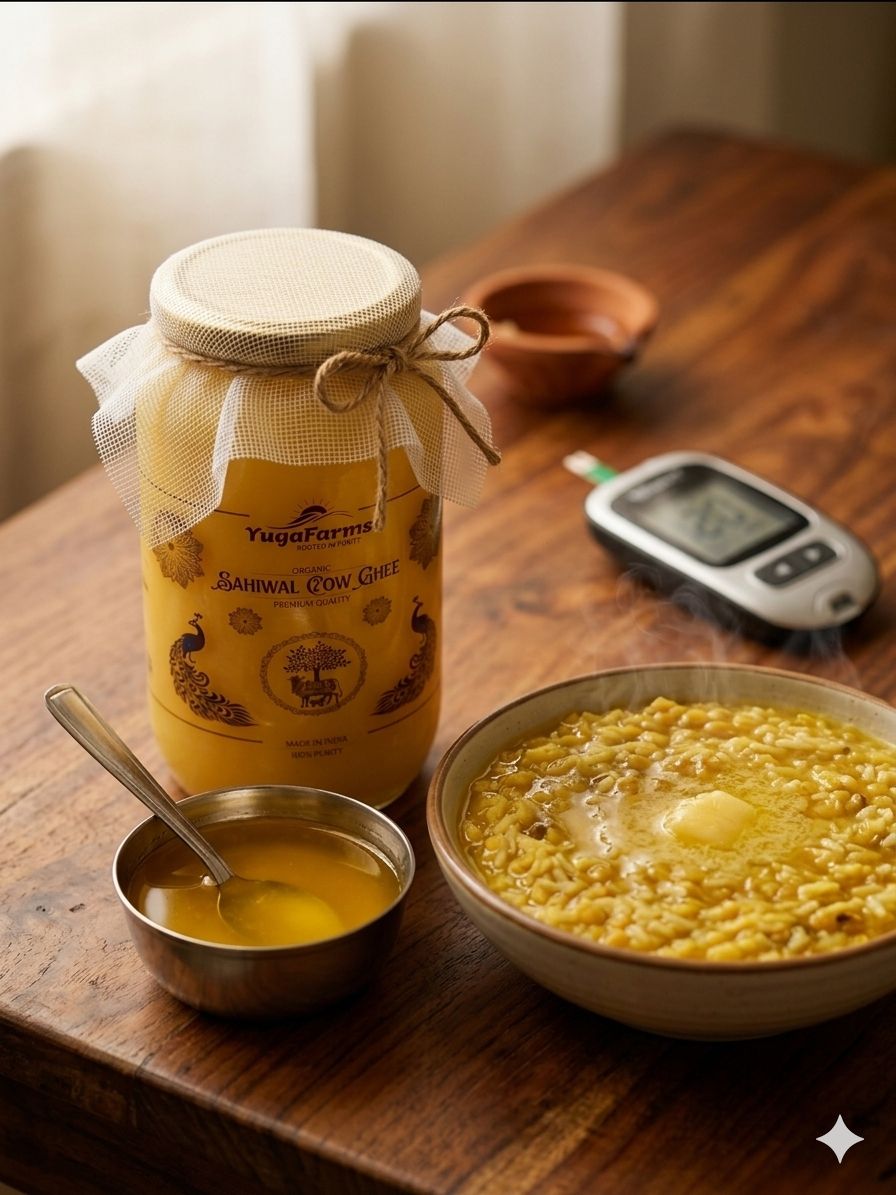
Is A2 Bilona Ghee Good for Diabetes? What the Science and Ayurveda Both Say
Published by YugaFarms · June 2026 · 12 min read
If you have diabetes in India, you've probably had this conversation.
Someone passes the ghee spoon. You hesitate. Someone else at the table says — "Isko mat do. Sugar hai inhe." And the ghee goes right past you.
It's one of those food rules that feels medical but nobody actually questioned. Ghee = fat. Fat = bad for diabetics. So: no ghee.
Here's the problem: that logic hasn't held up. India has over 101 million people living with diabetes — the highest number of any country in the world. And yet the one traditional fat our ancestors ate for thousands of years — desi ghee, made the bilona way from desi cows — has been quietly removed from diabetic diets while refined vegetable oils took its place.
Did that help? The data suggests it didn't.
This blog is a serious look at what A2 Bilona Ghee actually does to blood sugar, insulin sensitivity, and metabolic health — based on research, not fear, and not blind tradition either.
Why Diabetics Were Told to Avoid Ghee
To understand the confusion, you have to go back to the 1970s and 80s.
The broad nutritional advice of that era was simple: fat raises cholesterol, cholesterol causes heart disease, and since diabetics are already at higher cardiovascular risk, they should avoid fat — especially saturated fat. Ghee is almost entirely fat. So ghee got banned from diabetic kitchens.
This logic had two problems.
First, fat itself doesn't spike blood sugar. Carbohydrates do. A food's glycemic impact is primarily determined by its carbohydrate content, not its fat content. Ghee has zero carbohydrates. Its glycemic index is zero.
Second, the saturated fat = bad for heart equation has been significantly challenged and revised by nutritional science over the past two decades. The type of fat, what it's eaten with, and what it replaces in the diet all matter enormously — and traditional bilona ghee has a very different nutritional profile from industrial fats.
What Actually Happens to Blood Sugar When You Eat Ghee
Let's be specific about the mechanism.
Ghee does not raise blood sugar directly. It contains no glucose, no fructose, no starch. When you eat ghee on its own — say, a teaspoon on an empty stomach — your blood glucose does not rise.
What ghee does do is influence how the rest of your meal behaves in your body. And this is where it gets interesting for diabetics.
Ghee lowers the glycemic index of the foods you eat it with.
When you add ghee to rice, roti, khichdi, or dal, the fat slows down the digestion and absorption of carbohydrates. Instead of carbs flooding your bloodstream all at once (causing a sharp spike), they're absorbed more gradually. The result is a lower, flatter blood sugar curve after meals — which is exactly what diabetics need.
A 2023 Indian study found that white rice cooked with just 10g of ghee raised postprandial (after-meal) glucose by only 12%, compared to 45% without ghee — due to the fat slowing carbohydrate absorption. This is not a trivial finding. For someone managing blood sugar, the difference between a 12% glucose rise and a 45% rise after every meal is the difference between manageable and dangerous.
This "glycemic dampening" effect is one reason that Ayurvedic physicians have always recommended adding a small amount of ghee to high-carbohydrate foods — rice, roti, khichdi — rather than eating them dry. It wasn't tradition for tradition's sake. It was practical metabolic wisdom.
The Clinical Research: What Studies Found
Beyond the mechanism, let's look at what actual clinical trials found when they tested ghee on diabetic patients.
A study published in the International Journal of Novel Research and Development (2022) by Sri Laxmi Varsha G. and Rawoof R. tested the effect of one teaspoon (5g) of cow ghee daily added to the structured diabetic diets of 50 clinically diagnosed patients over six weeks.
The results were striking:
- Random blood glucose dropped from 212 to 176 mg/dL in one group and from 219 to 159 mg/dL in another
- Fasting glucose showed reductions from 124 to 99 mg/dL and from 121 to 95 mg/dL within three weeks
- Postprandial blood glucose also declined consistently across measurements
To be clear: one teaspoon of ghee per day, added to an otherwise unchanged diabetic diet, produced measurable improvements in blood sugar across multiple measurement types. No new medication. No dramatic diet overhaul. Just ghee.
This doesn't mean ghee is a diabetes medication — it isn't. But it does strongly suggest that excluding ghee from diabetic diets was not only unnecessary, but may have been counterproductive.
The Compounds in A2 Bilona Ghee That Matter for Diabetics
Not all ghee is the same. A2 Bilona Ghee — made from the milk of indigenous desi cows like Sahiwal using the traditional bilona hand-churning method — contains a specific set of bioactive compounds that are directly relevant to blood sugar and metabolic health.
Conjugated Linoleic Acid (CLA)
CLA is a naturally occurring fatty acid that bilona ghee contains in significantly higher amounts than industrial ghee (~2.5% vs ~0.7%). Research has found that CLA may improve insulin sensitivity — the core metabolic problem in Type 2 diabetes. Better insulin sensitivity means your body's cells respond more effectively to insulin, so glucose is taken up from the bloodstream more efficiently and blood sugar stays lower.
Butyric Acid
Butyric acid is a short-chain fatty acid found abundantly in traditionally made ghee. In the gut, butyric acid nourishes the gut lining, reduces intestinal inflammation, and supports the diversity and health of the gut microbiome. This matters for diabetics because gut health and the microbiome are now understood to play a significant role in glucose metabolism and insulin regulation. A healthier gut = better blood sugar control.
Omega-3 Fatty Acids and Linolenic Acid
Bilona ghee has a more favourable omega-3:omega-6 ratio (~0.69) compared to industrial ghee (~0.5) and dramatically better than refined vegetable oils (often below 0.1). Linolenic acid — an omega-3 fatty acid present in traditional ghee — has been specifically associated with reduced cardiovascular risk, which is especially important for diabetics given that heart disease is the leading cause of death among people with Type 2 diabetes.
Fat-Soluble Vitamins: A, D, E, and K2
Diabetes, particularly long-standing Type 2 diabetes, is often associated with nutrient deficiencies. Vitamin D deficiency is extremely common in Indian diabetics and is linked to worsened insulin resistance. Vitamin A supports immune function, which is frequently compromised in diabetics. Vitamin K2 directs calcium away from blood vessels — and arterial calcification is a major concern in long-term diabetes management.
A2 Bilona Ghee, properly made from the milk of grass-fed or fodder-fed desi cows, carries all four of these fat-soluble vitamins in bioavailable form.
Medium-Chain Triglycerides (MCTs)
Ghee contains MCTs — fats that are metabolized differently from long-chain fatty acids. MCTs go directly to the liver for energy production rather than being stored as body fat. They support fat oxidation (burning fat for fuel instead of glucose), reduce visceral fat accumulation (a key diabetes risk factor), and provide energy without requiring insulin to metabolise. For diabetics, this is a meaningful metabolic advantage.
What Ayurveda Knew About Ghee and Metabolism
Ayurvedic texts classified ghee — called ghrita — as a deepaniya substance: something that kindles and supports digestive fire (agni). In Ayurvedic understanding, weak or disturbed agni is the root cause of most metabolic disorders, including what we today call diabetes (referred to as Prameha or Madhumeha in classical texts).
The Charaka Samhita describes ghee as tridosha-shamaka — balancing to all three doshas — and as one of the most valuable of all foods for nourishing the body's deeper tissues. Importantly, Ayurvedic physicians did not exclude ghee from the diets of Prameha patients. They prescribed it in careful, moderate amounts as part of a whole-food, low-sugar dietary regimen.
The traditional wisdom was not "ghee is dangerous." It was "ghee is powerful — use it with understanding." The understanding being: pure ghee, in moderate quantities, as part of a nourishing diet, is therapeutic. Impure ghee (adulterated, processed, old) or excessive ghee as part of a high-calorie, high-sugar lifestyle — that's where problems arise.
Modern research is validating this distinction with increasing precision.
The Real Dietary Villains for Indian Diabetics
Here's what often gets missed in the conversation about ghee and diabetes.
When Indian households removed ghee from diabetic diets, they typically didn't replace it with vegetables. They replaced it with refined vegetable oils — sunflower, soybean, cottonseed, and refined palm oil. And these oils:
- Are ultra-high in omega-6 fatty acids, which promote inflammatory pathways directly linked to insulin resistance
- Oxidise at high cooking temperatures, producing harmful compounds that damage blood vessel walls
- Have been processed with chemical solvents (hexane), bleaching agents, and deodorisers
- Contain zero of the nutrients (CLA, butyrate, vitamins A/D/K2) that traditional ghee provides
The foods that most dramatically spike blood sugar in Indian diabetic diets are not fats at all — they are white rice eaten in large portions, refined maida products (bread, biscuits, packaged snacks), sugary beverages, and ultra-processed foods. Removing ghee while keeping these foods in the diet and replacing ghee with refined oils was, nutritionally speaking, a poor trade.
How Much Ghee Is Safe for Diabetics?
This is where we want to be honest, because moderation genuinely matters here.
The research supports:
- 1 teaspoon (5g) per meal, added to food — not eaten separately in large quantities
- 2–3 teaspoons per day total as a replacement for refined cooking oils, not in addition to them
- Consistency over time — the blood sugar benefits in the 2022 Indian clinical study appeared within three weeks of daily use at this dose
What to avoid:
- Using ghee as a topping on top of an already high-fat, high-calorie meal
- Consuming more than 3–4 teaspoons per day, especially if you are overweight or have significant insulin resistance
- Relying on ghee without addressing the carbohydrate load of your diet — ghee lowers the glycemic impact of the foods you eat, but it cannot fully compensate for a diet heavily dominated by refined carbohydrates
The key principle: ghee is a fat replacement, not an addition. If you cook in refined sunflower oil today, switching to ghee is a net upgrade. If you're already eating a rich, high-calorie diet and adding ghee on top, that's a different conversation.
Practical Guide: How to Use A2 Bilona Ghee If You Have Diabetes
Start with one teaspoon a day. Add it to your morning meal — either a small amount on roti or stirred into warm dal. Monitor how you feel and, if you track your glucose, note your postprandial readings.
Replace refined oil with ghee for tadka and cooking. This is the single most impactful switch. Sunflower oil in your tadka → A2 Bilona Ghee. You reduce omega-6 load, increase butyrate and CLA intake, and improve the stability of the fat at high temperatures.
Add a small knob to rice or khichdi. The glycemic dampening effect is most powerful when ghee is added directly to carbohydrate-rich foods before eating them. Even 1 teaspoon on a bowl of rice can meaningfully alter how that rice affects your blood sugar curve.
Use ghee for light sautéing instead of refined oils. Ghee's smoke point (~250°C) is one of the highest of any cooking fat, making it inherently more stable and less prone to oxidation than most vegetable oils.
Give it 4–6 weeks before evaluating. Dietary changes take time to show up in blood markers. If you're monitoring HbA1c or fasting glucose, establish a baseline before you start and reassess after consistent use.
A2 Bilona Ghee vs Regular Ghee for Diabetics: What's the Difference?
| Feature | A2 Bilona Ghee (YugaFarms) | Commercial/Regular Ghee |
|---|---|---|
| Milk source | A2 milk from Sahiwal desi cows | Often A1 milk from HF/crossbred cows |
| BCM-7 peptide | Absent | Present (linked to inflammation) |
| CLA content | ~2.5% | ~0.7% |
| Omega-3:Omega-6 ratio | ~0.69 (favourable) | ~0.5 (less favourable) |
| Butyric acid | Present, higher levels | Present, lower levels |
| Fat-soluble vitamins | A, D, E, K2 — retained | Partially degraded |
| Processing method | Traditional bilona, slow-cooked | Industrial cream separation |
| Gut impact | Supportive (A2 protein, butyrate) | Potentially inflammatory (BCM-7, A1) |
The difference matters for diabetics because inflammation is at the root of insulin resistance. A2 Bilona Ghee's composition — higher CLA, no BCM-7, better omega ratio, more butyrate — creates an anti-inflammatory internal environment. Commercial ghee made from A1 milk through industrial processing doesn't offer the same profile.
Frequently Asked Questions
Q: Can a diabetic eat ghee daily? A: Yes, in moderate amounts (1–2 teaspoons per day with meals). Research supports that daily consumption of ghee at these levels does not raise blood sugar and may actually improve glycemic parameters over time. The key is using it as a replacement for refined oils, not as an addition to an already calorie-rich diet.
Q: Does ghee raise blood sugar levels? A: No. Ghee contains zero carbohydrates and has a glycemic index of zero. It does not directly raise blood glucose. It actually helps lower the glycemic impact of carbohydrate-rich foods eaten alongside it by slowing carbohydrate absorption.
Q: Is A2 ghee better than regular ghee for diabetics? A: Yes. A2 Bilona Ghee has higher CLA content (associated with improved insulin sensitivity), is free from the BCM-7 peptide (which may promote inflammation), and has a better omega-3 to omega-6 ratio — all of which are directly relevant to metabolic health and blood sugar management.
Q: How much ghee per day is safe for a Type 2 diabetic? A: Most research points to 1 teaspoon (5g) per meal, totalling 2–3 teaspoons per day. This amount has been studied in clinical settings and shown to improve blood sugar parameters without adverse effects. More than this — especially without reducing refined carbohydrates — is not recommended.
Q: Can ghee replace diabetes medication? A: No. Ghee is a food, not a pharmaceutical intervention. If you are prescribed diabetes medication, continue it as directed by your doctor. Dietary improvements like incorporating quality ghee can complement medical management, but should not replace it.
Q: Is ghee good for insulin resistance? A: The CLA in bilona ghee has been associated with improved insulin sensitivity in research. Butyric acid's support of gut health also has downstream effects on glucose metabolism. Combined with the fact that ghee doesn't spike blood sugar and reduces the GI of the foods it's eaten with, it supports — rather than worsens — insulin resistance management.
Q: Can I eat ghee with rice if I'm diabetic? A: Yes — and this combination is actually supported by research. Adding 1 teaspoon of ghee to rice before eating significantly reduces the postprandial blood sugar spike from the rice. Traditional Indian cooking (dal-chawal with ghee) reflected this understanding long before modern research confirmed it.
Q: Is buffalo ghee or cow ghee better for diabetics? A: Cow ghee (especially A2 Sahiwal bilona ghee) is generally preferred for diabetics because of its higher CLA content, lower overall fat density per gram, and better nutrient profile. Buffalo ghee is richer and heavier — more appropriate for those who need caloric density rather than metabolic support.
Q: What time of day is best to have ghee for diabetes? A: Most Ayurvedic practitioners recommend a small amount in the morning on an empty stomach (half a teaspoon) to stimulate digestive fire, plus ghee added to meals throughout the day. Eating ghee late at night in large quantities is not recommended.
Q: Is ghee good for Type 1 diabetes? A: Type 1 diabetes involves autoimmune destruction of insulin-producing cells and requires insulin therapy. Ghee's anti-inflammatory properties (butyrate, CLA) may support immune health and gut integrity — areas relevant in Type 1 management — but its role here is less studied. People with Type 1 should discuss any dietary changes with their care team.
The Bottom Line
The idea that ghee is dangerous for diabetics is not supported by the evidence — especially when the ghee is pure, made from A2 milk, and prepared using the traditional bilona process.
What the research actually shows:
- Ghee has a glycemic index of zero — it does not raise blood sugar directly
- Ghee lowers the glycemic impact of carbohydrate-rich foods when eaten together
- One teaspoon of cow ghee per day has been shown in clinical studies to reduce fasting and postprandial blood glucose levels over six weeks
- A2 Bilona Ghee contains CLA, butyric acid, and omega-3 fatty acids that support insulin sensitivity and metabolic health
- Replacing refined vegetable oils with ghee reduces inflammatory omega-6 load — directly relevant to insulin resistance
- Ayurveda has recommended moderate ghee consumption as part of diabetic management for thousands of years
The key word in all of this is quality. Adulterated ghee, commercial industrial ghee made from A1 milk — these don't carry the compounds that make traditional ghee beneficial. FSSAI data has consistently shown high rates of adulteration in packaged ghee products. What you put in your body matters. Lab-tested, farm-produced, bilona-method ghee from a transparent source is the version worth seeking out.
Don't let a 50-year-old nutritional oversimplification keep you away from one of India's most nourishing traditional foods — particularly if you're one of the 101 million Indians who need every metabolic advantage available.
At YugaFarms in Palwal, Haryana, our A2 Sahiwal Bilona Ghee is made from the milk of our own Sahiwal cows using the traditional hand-churning process. Every batch is lab-tested and FSSAI certified. No adulteration. No shortcuts.
Explore our A2 Sahiwal Bilona Ghee →
First order? Use code FIRSTGHEE for 8% off.