
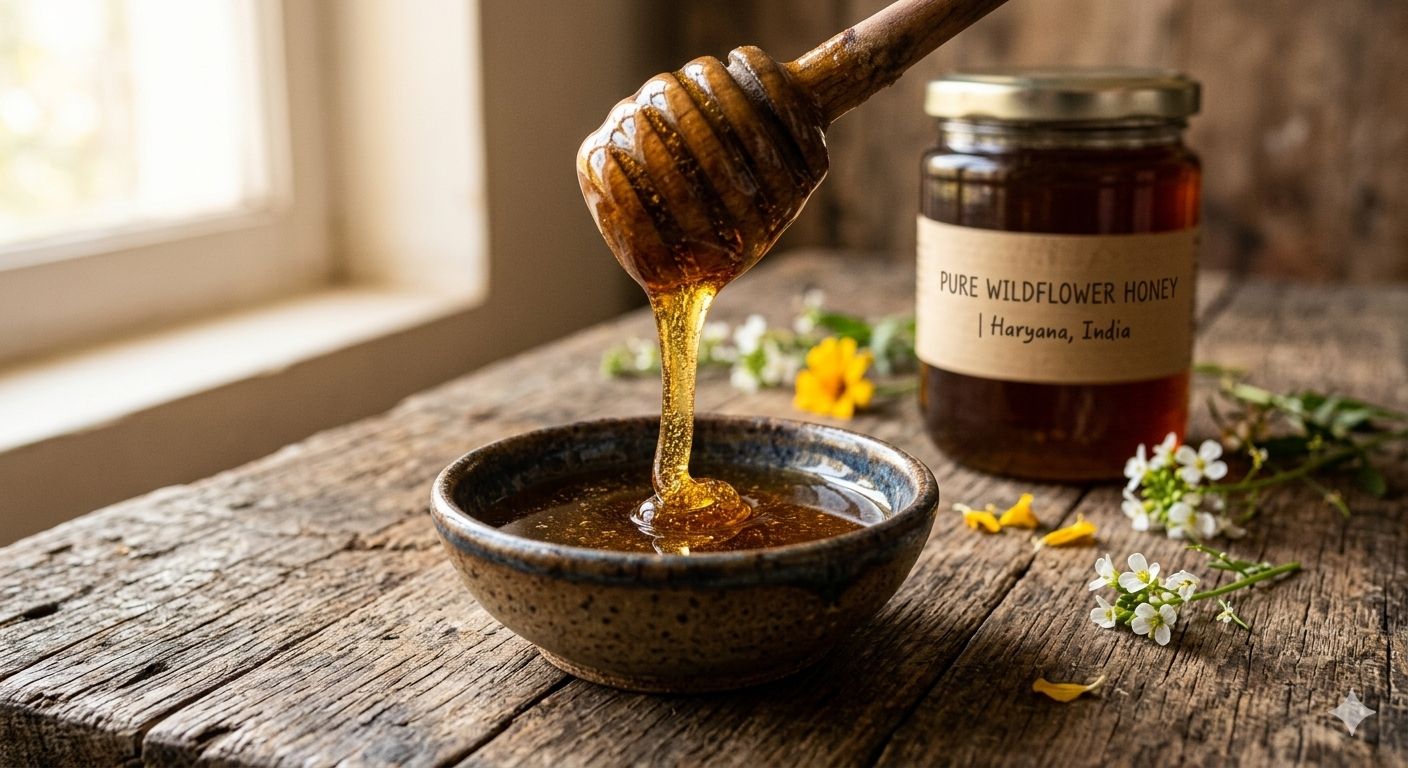
Raw Honey vs Processed Honey: What's Actually in That Supermarket Jar (And Why It Matters)
Published by YugaFarms · June 2026 · 10 min read
There's a jar of honey sitting in most Indian kitchens right now. It has a golden colour, a clean label, and a price that feels reasonable. It pours smoothly, stays perfectly liquid through every season, and tastes consistently sweet.
None of that is normal for real honey.
This is not a scare piece. But if you've been reaching for that jar every morning — stirring it into warm water, drizzling it on fruit, giving it to your children — it's worth understanding what you're actually consuming. Because genuine raw honey and the processed honey sold in most supermarkets share a name and not much else.
We produce raw multifloral honey at YugaFarms, sourced from hives in the forests and farmlands around Haryana. We've had people ask us why our honey crystallises, why the colour varies between batches, why it looks nothing like what they've bought before. These are the right questions. This blog is the full answer.
The Problem With "Pure Honey" Labels
Walk down the honey aisle of any Indian grocery store and almost every jar says the same thing: pure, natural, 100% honey. There is no regulation in India that stops a brand from making these claims even if the product has been ultra-filtered, heated to temperatures that destroy enzymes, or adulterated with sugar syrup.
The Food Safety and Standards Authority of India (FSSAI) has standards for honey — they exist on paper. But enforcement is inconsistent, and the tests used to detect adulteration have historically been easy to circumvent. A 2020 investigation by the Centre for Science and Environment found that many leading honey brands in India failed adulteration tests when tested for sugar syrups that don't show up on standard NMR testing. Several major brands — names most Indian households would recognise — were implicated.
The point is not that all commercial honey is adulterated (some is fine). The point is that the label cannot be trusted at face value. To understand what you're buying, you need to understand what processing actually does to honey — and what raw honey is when it hasn't been touched.
What Happens to Honey When It's Processed
Commercial honey production involves two primary interventions that fundamentally alter the product: heat treatment and ultra-filtration.
Heat Treatment
Raw honey contains naturally occurring enzymes — most importantly diastase and invertase — that are produced by bees during the honey-making process. These enzymes are sensitive to heat. When honey is heated above approximately 40°C (the temperature of a healthy beehive), enzyme activity begins to decline. At 70°C and above, most enzymes are destroyed entirely.
Why heat it at all? To make it pour faster, to extend shelf life, and to slow crystallisation — all of which improve the experience of selling honey, not the experience of consuming it.
Heating also destroys the hydrogen peroxide activity that gives raw honey its antimicrobial properties, reduces the concentration of antioxidants, and alters the natural sugar composition of the honey.
Ultra-Filtration
Raw honey naturally contains pollen. These tiny pollen grains are not impurities — they are among the most nutritionally important components of honey. Pollen contains amino acids, vitamins, flavonoids, and antioxidants. It also contains the geographical fingerprint of the honey: the plant species the bees visited, the region where the honey was made.
Ultra-filtration removes pollen so completely that there is no trace of it left. This is done partly for appearance (clearer honey looks more "premium") and partly to make honey impossible to trace back to its source — which is useful when you're blending honey from multiple countries or adding adulterants.
In 2011, the US Food Safety News published a study finding that 76% of honey purchased from US supermarkets contained no pollen at all. Ultra-filtered honey, under European Union and US standards, technically cannot be called honey at all — because without pollen, it cannot be verified as a genuine bee product.
In India, no equivalent regulation currently exists.
What Raw Honey Actually Contains
Real honey — extracted at low temperatures, minimally filtered to remove wax and large debris, and jarred without heating — is a remarkably complex substance.
Enzymes
The most important is diastase (also called amylase), which breaks down starches. FSSAI honey standards actually specify a minimum diastase activity level (DN ≥ 8) as a freshness indicator — because highly processed or old honey loses diastase activity. When you buy raw honey and check for diastase in a lab report, you can verify that it hasn't been stripped by heat.
Glucose oxidase produces hydrogen peroxide in diluted honey, which is the basis of honey's well-documented antimicrobial properties. This is why raw honey applied to a wound inhibits bacterial growth. This activity is largely absent in heated honey.
Antioxidants
Raw honey is rich in flavonoids and phenolic acids — particularly quercetin, kaempferol, luteolin, and caffeic acid. These vary by floral source (more on that shortly), but multifloral raw honey from diverse plant sources tends to have a broader antioxidant profile than single-source commercial honey.
Antioxidant levels drop significantly with processing. A study published in the Journal of Agricultural and Food Chemistry found that heat treatment caused meaningful reductions in phenolic content and antioxidant capacity. The darker the raw honey, in general, the higher the antioxidant load — which is why dark forest honeys, like the buckwheat honey common in Himalayan regions, are particularly valued.
Pollen
Beyond being a tracer of authenticity, pollen in honey contributes amino acids, B vitamins, carotenoids, and additional flavonoids. Some Ayurvedic practitioners have used pollen-rich honey as a natural desensitisation approach for seasonal allergies — the theory being that small, regular exposure to local pollen builds tolerance. The evidence base for this is not definitive, but the traditional use is centuries old.
Prebiotics
Raw honey contains oligosaccharides — complex sugars that are not digested in the small intestine but pass to the colon where they serve as fuel for beneficial bacteria. The prebiotic effect of raw honey is well-documented in food science literature. Processed honey retains some of this, but the overall microbiome-supportive profile is more intact in unheated honey.
Natural Sugars in Proportion
Honey is primarily fructose and glucose — approximately 38% and 31% respectively — with the remainder being water, oligosaccharides, and trace compounds. The ratio of fructose to glucose determines how quickly honey crystallises. This is important: crystallisation is a sign of purity, not spoilage, and we'll return to this.
Multifloral vs Monofloral Honey: What's the Difference?
You'll see both terms used when buying honey, sometimes without much explanation.
Monofloral honey is produced when bees forage predominantly from a single plant species. Manuka honey (from the Leptospermum plant in New Zealand and Australia) is the most famous example globally. Ajwain honey, Jamun honey, and Mustard honey are well-known Indian monofloral varieties. Each carries distinct flavour characteristics and sometimes elevated concentrations of specific compounds — Manuka's MGO (methylglyoxal) content, for example, is studied for its antimicrobial properties.
Multifloral honey — sometimes called wildflower honey — is produced when bees forage across many plant species in a given area. It is not a lesser product. In many ways, it is more representative of what traditional honey always was — before commercial beekeeping began managing hives to produce large volumes of single-source honey.
The honey we produce at YugaFarms is multifloral, sourced from hives in regions where bees access a diverse mix of seasonal flowers, trees, and crops. Each batch has a slightly different character. The summer batches tend to be lighter and more floral. Post-monsoon honey from the same region often runs darker and more complex. This variation is normal. It is evidence that the honey is real.
Why Good Honey Crystallises (And What to Do About It)
This might be the most common point of confusion for people switching from commercial to raw honey.
Raw honey crystallises. Sometimes quickly, sometimes slowly, but it almost always will — because it is a supersaturated solution of sugars, and under normal conditions, glucose molecules will organise themselves into crystals over time. Honeys high in glucose (like mustard or rapeseed honey) crystallise very fast — sometimes within weeks. Honeys higher in fructose (like acacia or forest honeys) crystallise slowly and may stay liquid for months.
Processed honey is heated and filtered specifically to delay or prevent this. The result is a product that stays liquid for a year or more — which looks better on a shelf but tells you nothing good about what's inside.
Crystallised raw honey has lost nothing. The nutritional profile is identical. The enzymes, antioxidants, and pollen are all present. To return it to a liquid state, simply place the jar in a bowl of warm water (40–45°C) for 20–30 minutes. Do not microwave it and do not use hot water — heat is the enemy of everything that makes raw honey worth buying.
Some people actually prefer crystallised honey. The texture is spreadable rather than pourable, it stays on toast instead of running off the edges, and the flavour is often perceived as richer and more concentrated. This is personal preference. Both states are equally good.
A Word on "Sugar Syrup Honey" and How to Spot It
Adulteration of honey with sugar syrup — typically inverted sugar syrup, rice syrup, or corn syrup — is a documented problem in India and globally. These syrups are cheap, look like honey, and can be difficult to detect without laboratory testing.
At home, there are a few rough tests worth knowing about, though none are definitive:
The water test. Drop a teaspoon of honey into a glass of room-temperature water without stirring. Pure honey tends to settle to the bottom as a coherent blob. Adulterated honey or honey with high sugar syrup content tends to dissolve more readily. This test is indicative but not conclusive.
The thumb test. Place a small drop on your thumb. Pure honey stays in place. Diluted or adulterated honey tends to spread or run. Again, this is a rough indicator only.
The burn test. Dip a cotton wick in honey and light it. Pure honey burns (though with some initial difficulty due to moisture content). Honey with added water or syrup will resist burning. This tests for excess moisture more than adulteration specifically.
The only reliable test is laboratory analysis — specifically NMR (Nuclear Magnetic Resonance) spectroscopy or LCMS (Liquid Chromatography Mass Spectrometry) testing for sugar profiles. This is what reputable brands should be using and sharing publicly.
Our lab reports at YugaFarms are available at yugafarms.com/lab-reports. We test every batch before it leaves the farm.
How Raw Honey Has Been Used in Indian Tradition
Honey appears in Ayurvedic texts going back thousands of years — and notably, ancient practitioners were extremely specific about the type of honey they were describing. The Sanskrit term Madhu referred to raw, unheated, minimally handled honey. Heated honey — called Kritanna Madhu — was classified differently and sometimes considered harmful rather than beneficial in Ayurveda, because applying heat to honey was believed to alter its fundamental properties.
This distinction between raw and heated honey, written in the Charaka Samhita and Sushruta Samhita, is functionally consistent with what modern food science tells us about enzyme destruction at elevated temperatures. The ancients did not have mass spectrometers, but they were careful, observational people who noticed what happened when honey was handled differently.
Traditionally, raw honey was used in Ayurveda as:
- A vehicle (anupan) for delivering other medicines — because it was believed to enhance the bioavailability of substances it carried
- A topical application for wounds, burns, and eye conditions
- An ingredient in Chyawanprash and other rasayana formulations
- A remedy for coughs, sore throats, and digestive complaints
- A food given to newborns as part of Jatakarma rituals (a drop on the tongue at birth)
Whether or not you follow Ayurvedic principles, the consistent use of raw honey — rather than processed honey — across traditional medicine systems worldwide is at minimum suggestive of accumulated experiential wisdom.
Ghee and Honey: A Traditional Pairing Worth Understanding
If you're already using A2 bilona ghee from native cow breeds, adding raw honey to your daily routine creates a pairing that Ayurveda describes as among the most complementary in the kitchen — with one important caveat.
Ayurvedic texts explicitly state that ghee and honey should not be consumed in equal quantities together. The combination in equal measure is considered viruddha ahara (incompatible food) and is said to create ama (metabolic waste) rather than nourishment. However, ghee and honey in unequal proportions — for example, a spoonful of ghee stirred into warm water alongside a separate teaspoon of honey — are used routinely in Ayurvedic practice and are not considered problematic.
The practical implication: don't combine them 1:1 in the same preparation. Use them separately, or in clearly unequal ratios.
Both ghee and honey, consumed independently in moderate quantities, form the backbone of what Ayurveda calls pathya — wholesome, appropriate food that supports rather than depletes. The combination of high-quality fat and natural sugar from real food sources is a far better breakfast habit than most alternatives on the market.
What to Look for When Buying Raw Honey in India
Most of the guidance here overlaps with what we've described for ghee — transparency, provenance, lab documentation. But there are honey-specific things to look for:
Source and region. Where do the bees forage? A honey labelled with a specific region or floral source means the producer knows where it comes from. Generic labels with no geographical specificity suggest bulk blending or importing.
Extraction method. Ideally, honey is extracted by cold-pressing or gravity drainage — without centrifuges that add heat. Cold extraction preserves enzyme activity better than even low-speed mechanical extraction.
Filtration level. A small amount of filtration is necessary to remove wax and debris. Ultra-filtration to achieve glass-clear honey is not necessary and removes pollen. "Minimally filtered" or "lightly filtered" on a label is a good sign.
Colour and consistency. Natural honey varies enormously in colour — from near-transparent pale gold to deep amber, red-brown, or near-black, depending on floral source and season. If every batch from a brand looks identical, something is being standardised that shouldn't be.
Crystallisation. If a honey has been liquid for more than 6–8 months without any sign of crystallisation, ask questions. Either it's been heated to prevent it, it's a high-fructose variety like pure acacia honey, or something else is keeping it liquid.
Lab reports. Diastase number (≥ 8 is the FSSAI minimum), HMF levels (hydroxy-methyl-furfural — a marker of heating or ageing), moisture content, and sugar profile should all be available from a producer committed to quality.
How We Source and Make Our Honey at YugaFarms
Our honey is multifloral, sourced from traditional beekeepers in the Haryana and neighbouring forest belt regions. The bees forage seasonally across a mixed landscape of farmland, scrubland, and natural flora. We do not manage the hives for single-source honey — the diversity is intentional.
Extraction is done by cold drainage. We filter once, lightly, to remove wax and hive debris. We do not heat. We test each batch at a third-party FSSAI-accredited laboratory and make the reports available on our website before the batch ships.
Each batch is limited. Honey is seasonal, and we don't blend batches to create consistency — which means the colour, texture, and flavour of what you receive may vary slightly between orders. We consider this a feature. Consistency in raw honey is a red flag, not a reassurance.
If you have questions about the specific batch you've received — its floral region, when it was extracted, what the lab results show — you can reach us at support@yugafarms.com. We're a small operation and we can actually answer these questions.
Frequently Asked Questions
Is raw honey safe for children under 1 year? No. Raw honey — like all honey — can contain Clostridium botulinum spores, which can cause infant botulism in babies under 12 months. The digestive system of infants is not yet developed enough to neutralise these spores. For children over 1 year, raw honey is considered safe and is a traditional part of the Indian diet.
Can diabetics eat raw honey? Raw honey has a lower glycaemic index than refined sugar and contains beneficial compounds that processed sugar lacks entirely. However, it still raises blood sugar — it is not a free food for diabetics. Anyone managing diabetes should consult their doctor about appropriate quantities. Small amounts (1 teaspoon) used as a food ingredient are generally considered differently from tablespoons consumed directly.
Why does my honey look different from the product photo? Because it's real. Natural honey varies in colour and clarity between batches, seasons, and floral sources. What you're seeing is not inconsistency — it is proof that the honey hasn't been standardised by processing.
How long does raw honey keep? Properly stored raw honey has an essentially indefinite shelf life when kept in an airtight container away from moisture, heat, and direct sunlight. Archaeological honey over 3,000 years old found in Egyptian tombs was reportedly still edible. The moisture content of honey is low enough to prevent microbial growth under normal conditions.
Does raw honey help with coughs? Honey has a well-established evidence base for soothing sore throats and suppressing coughs — better, in several clinical studies, than over-the-counter cough suppressants in children above 1 year. The WHO and NHS both note honey as an effective home remedy for acute coughs. The mechanism is believed to involve the coating effect of the thick liquid and the antimicrobial properties of raw honey. Whether raw honey performs better than commercially processed honey in this context has not been definitively studied, but given what we know about the role of enzymes and antioxidants, the assumption is that raw honey would at minimum be equivalent.
The Bottom Line
The honey in most Indian kitchens is not honey in any meaningful traditional sense. It is a processed food product that resembles honey in colour and sweetness but has been stripped, through heat and filtration, of most of what made honey a valued food for thousands of years.
Raw honey — genuinely raw, tested, traceable — is a different thing. It takes more care to produce, stores less conveniently, and behaves unpredictably on a shelf because it's alive in a way that processed honey is not. The crystallisation, the batch variation, the complexity of flavour — these are not problems to engineer away. They are the product.
The switch from commercial to raw honey is, for most people, immediately perceptible. The taste alone is the argument.
YugaFarms produces small-batch raw multifloral honey and A2 Sahiwal Bilona Ghee from our farm in Palwal, Haryana. FSSAI certified · ISO 9001:2015 · Lab reports publicly available. Use code FIRSTGHEE for 8% off your first order.