
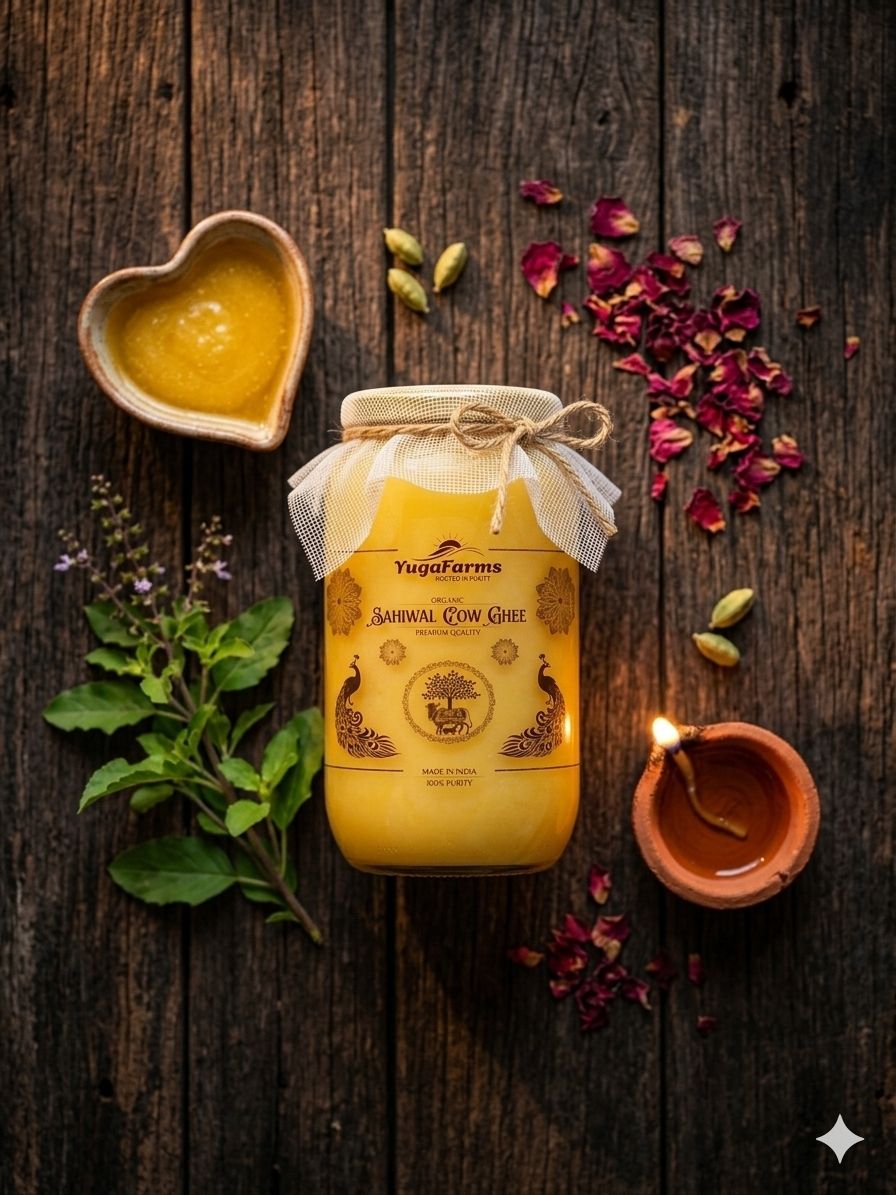
Is Ghee Bad for Cholesterol and Heart Health? The Truth Behind the Fear
Published by YugaFarms · June 2026 · 11 min read
At some point in the last few decades, Indian families quietly removed ghee from their kitchens and replaced it with refined sunflower oil. Not because anyone cooked worse. Not because the food tasted better. But because a doctor, or a brochure, or a well-meaning relative told them that ghee was bad for the heart.
That belief has now been running for nearly forty years. And in those same forty years, rates of heart disease in India have not gone down. They have gone up — significantly, consistently, and in a way that doesn't map at all to a reduction in ghee consumption.
This is not a coincidence worth ignoring.
I'm not writing this to be contrarian or to tell you that ghee is medicine for your arteries. It isn't, and anyone who says otherwise is oversimplifying. But the story of ghee and cholesterol is far more nuanced than "saturated fat raises cholesterol and cholesterol causes heart attacks" — and the nuance actually matters for what you put in your kitchen.
Where the Fear Came From
The anti-ghee movement in India largely followed the tail end of a global campaign against saturated fat, which was built around research from the 1960s and 70s. The core argument was: saturated fat raises LDL cholesterol, high LDL cholesterol causes arterial plaque, arterial plaque causes heart attacks. Therefore, saturated fat causes heart attacks.
It was a clean, logical chain. It was also incomplete.
What the early research didn't adequately account for — and what decades of subsequent work has complicated significantly — is that:
Not all LDL is the same. LDL exists in small, dense particles (which are more atherogenic) and large, buoyant particles (which are largely benign). Saturated fat raises LDL, but it primarily raises the large, buoyant kind.
Not all saturated fat is the same. The saturated fatty acids in ghee — primarily stearic acid and palmitic acid — behave differently in the body than the industrially processed trans fats that were consumed in the same era and often lumped together in studies.
Cholesterol numbers alone are a poor predictor of cardiac risk. The ratio of HDL to LDL, triglyceride levels, inflammatory markers like CRP and homocysteine, and lifestyle factors are all more predictive than total cholesterol alone. And on several of these markers, ghee performs better than refined seed oils.
The early research gave us a plausible hypothesis. It became dietary policy before the hypothesis was properly tested. And in India, it displaced a food — traditional ghee — that had coexisted with relatively low rates of heart disease for centuries, in favor of refined vegetable oils that had not been eaten by humans in any meaningful quantity before the 20th century.
What Ghee Actually Does to Your Cholesterol
This is where I want to be careful and specific, because the honest answer is: it depends on the ghee, the quantity, the overall diet, and the individual.
Here's what the research broadly suggests:
Ghee raises HDL. Multiple studies — including Indian clinical trials — have shown that moderate ghee consumption raises HDL (high-density lipoprotein) cholesterol, commonly referred to as the "good" cholesterol. HDL particles perform reverse cholesterol transport, pulling cholesterol from arterial walls and returning it to the liver for processing. Higher HDL is consistently associated with lower cardiac risk across large population studies.
Ghee does not meaningfully raise small, dense LDL. As noted above, the LDL-raising effect of dietary saturated fat is primarily in the large buoyancy-dominant particles, which are not independently associated with increased cardiac events. A 2010 meta-analysis in the American Journal of Clinical Nutrition reviewed 21 prospective studies covering over 300,000 subjects and found no significant association between saturated fat intake and cardiovascular disease.
Ghee contains CLA. Conjugated Linoleic Acid (CLA) is a naturally occurring fatty acid found in the fat of grass-fed ruminants. In A2 bilona ghee made from the milk of pasture-fed cows like Sahiwal, CLA content is notably present. CLA has been studied for anti-inflammatory effects and has shown favorable associations with cardiovascular risk markers in several trials.
Ghee contains vitamin K2. This is the nutrient most people have never heard of, and it may be one of the most important in this entire discussion. Vitamin K2 (specifically MK-4) plays a direct role in directing calcium away from arterial walls and toward bones and teeth — the exact opposite of what causes arterial calcification. Arterial calcification is a key driver of atherosclerosis. Ghee from grass-fed A2 cows is one of the few reliable dietary sources of vitamin K2 in the Indian diet.
Ghee does not oxidize under heat. This is crucial. Refined polyunsaturated oils — sunflower, soybean, corn — oxidize when heated. Oxidized fats generate free radicals and advanced glycation end-products (AGEs), both of which drive inflammation and arterial damage. Ghee's high saturated fat content makes it inherently stable at cooking temperatures. The fat you cook with matters as much as the fat itself. Ghee cooked at high heat is chemically stable. Sunflower oil at the same temperature is actively producing harmful compounds.
None of this means you should eat ghee without limit or in place of medical advice. But taken together, the picture that emerges is quite different from "ghee damages your heart."
The Refined Oil Substitution Problem
When ghee left Indian kitchens in the 1980s and 90s, it wasn't replaced by nothing. It was replaced — largely by refined sunflower oil, soybean oil, and eventually partially hydrogenated vegetable shortenings (vanaspati), which contain trans fats.
Trans fats are the one category of dietary fat where the "bad for the heart" evidence is unambiguous. They raise LDL, they lower HDL, they increase systemic inflammation, and they have been documented to increase cardiovascular mortality in large epidemiological studies. Multiple countries have banned them entirely.
In the period when India was reducing ghee consumption and increasing refined oil consumption, heart disease rates in urban India rose from roughly 1-2% of deaths in the 1960s to the world's highest absolute burden of cardiovascular disease by the early 2000s. Epidemiology is not mechanism — you can't draw a direct line from one data point to another. But the idea that removing ghee protected Indian hearts is hard to square with what the trajectory of Indian cardiac health actually looked like.
The replacement food was worse than the original. And it was sold as an upgrade.
A2 Bilona Ghee Specifically — Why It's Different from Commercial Ghee
Not all ghee has the same nutritional profile, and this matters when evaluating the research.
Much of the older Indian research on ghee used commercially prepared ghee from hybrid or A1-dominant cows, processed through cream separation rather than the traditional bilona method. That ghee and A2 Sahiwal bilona ghee are different products in meaningful ways.
A2 milk comes from desi Indian breeds — Sahiwal, Gir, Rathi, Tharparkar — whose milk contains the A2 beta-casein protein rather than the A1 beta-casein found in hybrid breeds. During digestion, A1 beta-casein produces a peptide called BCM-7, which has been linked to gut inflammation and — in some research — to cardiac risk. A2 milk does not produce BCM-7. This is not the same as saying A2 ghee prevents heart disease, but it means ghee made from A2 milk is free of a compound that A1-based commercial ghee may introduce.
The bilona method involves fermenting full-cream milk into curd overnight before churning. This fermentation step increases the butyric acid content of the final ghee, retains fat-soluble vitamins that are degraded by industrial heat processing, and produces a ghee that smells and tastes genuinely different from commercial products. The nutritional differences are real, not merely marketing language.
Pasture-fed Sahiwal cows produce milk with higher CLA and vitamin K2 content than grain-supplemented, stall-fed animals. At YugaFarms, our Sahiwal cows in Palwal graze on natural forage. Our ghee is not made from collected milk purchased off a truck — it comes from animals we maintain, which means the nutritional quality of the starting material is known.
When you evaluate "ghee and cholesterol," you should be asking: which ghee? Made how? From which animals? The answer changes what the evidence actually applies to.
Who Should Still Be Careful
A balanced piece on this topic should say it plainly: there are people for whom higher saturated fat intake is genuinely worth monitoring.
If you have familial hypercholesterolemia — a genetic condition that causes very high LDL independent of diet — dietary fat modification may matter more for you than for the general population, and you should work with a doctor.
If your LDL is already elevated and your doctor is actively managing it, changes to your fat intake should happen in dialogue with them, not based on a blog post.
If you have existing gallbladder disease or a documented fat metabolism disorder, concentrated dietary fat warrants extra care.
For the majority of healthy adults who are eating ghee in reasonable quantities — one to two teaspoons per day — the evidence does not support the level of fear that surrounds it. The framing that a teaspoon of traditional ghee on your dal is a cardiac risk, while refined sunflower oil at the same meal is neutral or beneficial, is not supported by the current weight of nutritional research.
The Simpler Version of This
Indian food, for most of its history, was cooked in ghee or cold-pressed oils. Indian rates of heart disease were low relative to the industrialized world. Industrial food processing, refined oils, high-sugar diets, and sedentary urban lifestyles arrived together. Heart disease rates rose together with all of them.
Ghee became the scapegoat because it fit a hypothesis that was popular at the time. That hypothesis has since been substantially revised by better research. The food industry that profited from replacing ghee with refined oil has not loudly announced this revision.
You don't have to take a strong ideological stance on any of this. You can simply look at what you know: your grandparents cooked in ghee, ate full-fat dairy, and many of them lived into their 80s without a cardiologist. The life they lived had fewer processed carbohydrates, less sugar, more physical activity, and — yes — more ghee.
The ghee was not the problem.
How Much Ghee Is Actually Reasonable
For a healthy adult with no specific medical contraindications, one to two teaspoons of ghee per day is supported by the range of research and traditional recommendations. This is roughly 5–10 grams of fat, which is a modest contribution to daily fat intake.
Two teaspoons a day in your dal, on your roti, or stirred into your khichdi is traditional, moderate, and — based on the evidence available — unlikely to cause harm and possibly beneficial.
What isn't moderate: using ghee as a topping on everything, eating several tablespoons daily, or consuming it alongside an already high-fat, high-processed-food diet and expecting the ghee to be the only variable that matters. Diet is a system. Ghee is one part of it.
Frequently Asked Questions
Does ghee increase triglycerides? Triglycerides are raised primarily by refined carbohydrates and sugar, not by dietary fat. Ghee consumed in moderate amounts, without being paired with a high-carbohydrate diet, does not independently raise triglycerides.
Is ghee safe after bypass surgery or a cardiac event? This is a question for your cardiologist, not a food blog. Post-cardiac dietary management is highly individual and depends on medications, existing arterial condition, and comorbidities.
Does grass-fed ghee have more CLA than regular ghee? Yes, substantively. CLA content in milk fat is directly related to how much natural forage the animal eats. Stall-fed grain-supplemented cows produce milk with significantly lower CLA than pasture-grazed animals.
Will ghee raise my LDL at my next blood test? It may raise total LDL modestly, depending on baseline and quantity. More importantly, it is likely to raise HDL as well, and the ratio between them is what most cardiologists consider more relevant than total LDL alone.
Is desi ghee better than olive oil for heart health? They are different fats suited to different uses. Olive oil is rich in oleic acid (monounsaturated) and has strong evidence for cardiac benefit in Mediterranean populations. Ghee is rich in saturated fat, butyrate, and fat-soluble vitamins, and has traditional use in South Asian cooking. Olive oil is not heat-stable enough for Indian high-temperature cooking. Ghee is. These are not competing products — they serve different roles.
What about people with high cholesterol in the family? Individual genetic factors do matter. If heart disease runs strongly in your family, closer monitoring and medical guidance on diet is appropriate — not blind avoidance of all saturated fat, but informed and monitored choices.
The Honest Conclusion
The idea that ghee is bad for your heart was built on a theory that has since been substantially qualified, and applied to a food that was mischaracterized in the process.
Real, traditional A2 bilona ghee — consumed in moderate, sensible amounts as part of an otherwise balanced diet — does not deserve the cardiac fear that surrounds it. It raises HDL. It carries vitamin K2. It is heat-stable in ways that refined oils are not. It contains butyrate. It is, in the most basic terms, a whole food that humans in this part of the world have been eating for centuries without the epidemic of heart disease that arrived alongside industrialization.
That doesn't make it a medicine. It makes it a real food, made honestly, that deserves to be evaluated on real evidence rather than 40-year-old policy.
YugaFarms produces small-batch A2 Sahiwal Bilona Ghee from our farm in Palwal, Haryana. FSSAI certified · ISO 9001:2015 · Lab reports publicly available. Use code FIRSTGHEE for 8% off your first order.