
A2 Bilona Ghee for Skin and Hair — YugaFarms
Published by YugaFarms · June 2026 · 10 min read
Most people who reach for ghee in their kitchen haven't thought of it as a skincare product. That's a relatively modern blind spot. For the last several thousand years, across Ayurveda, Unani medicine, and traditional household practice across South Asia, ghee was applied to skin and scalp as routinely as it was eaten. Newborns were massaged with it. Cracked heels were healed with it. Hair was conditioned with it.
The question worth asking in 2026 is not whether ghee has traditionally been used this way — it clearly has — but whether there's a real physiological basis for the practice. And more specifically, whether A2 Bilona ghee does something that regular ghee or commercial moisturisers don't.
The honest answer is: yes, with specifics that matter.
Why Ghee Was the Original Skincare Ingredient
Ayurveda classifies ghee as a snehana dravya — a substance with intrinsic oleation properties. The word sneha in Sanskrit means both fat and love, which is not an accident. The concept of nourishing something through fat was considered analogous to the act of caring for it. Internally and externally, ghee was the medium through which the body was sustained, lubricated, and protected.
Classical texts — the Charaka Samhita, Sushruta Samhita, and Ashtanga Hridayam — describe ghee-based formulations (called ghrita) for skin conditions ranging from dryness and burns to wounds and inflammatory eruptions. The external application of plain ghee was considered appropriate for everyday use, while medicated ghrita (infused with herbs) was reserved for therapeutic treatment.
The question, from a modern perspective, is what the underlying mechanism is. And it turns out that ghee has several properties that make it genuinely useful on skin — not just plausible or traditional, but chemically explainable.
What Makes A2 Bilona Ghee Effective on Skin
1. Fat-Soluble Vitamins That Actually Absorb
A2 Bilona ghee contains meaningful quantities of vitamins A, D, E, and K2. These are fat-soluble vitamins — they do not dissolve in water, which means they require a lipid carrier to penetrate the skin barrier effectively. Ghee is that carrier.
Vitamin A (retinol in its natural form) is the most studied skincare ingredient in dermatology. It promotes cell turnover, supports collagen synthesis, and is used clinically in retinoid form to treat ageing, acne, and pigmentation. The vitamin A in ghee is not pharmaceutical-grade retinol — but it is the real, naturally occurring form, and it reaches the skin in a bioavailable lipid matrix rather than a synthetic suspension.
Vitamin E is the skin's primary fat-soluble antioxidant. It protects cell membranes from oxidative damage, supports wound healing, and has a well-documented moisturising effect. Ghee from pasture-fed A2 cows contains significantly more vitamin E than ghee from stall-fed or hybrid-breed animals, because vitamin E synthesis is linked to carotenoid intake from green grass.
Vitamin K2 is less commonly discussed in skincare, but research is emerging on its role in reducing dark circles under eyes (by supporting blood vessel integrity) and potentially in conditions like skin calcification.
2. Butyric Acid and the Skin Barrier
Butyric acid — present in meaningful amounts in bilona ghee due to the fermentation step in traditional processing — is not just a gut health compound. The skin's own microbiome produces short-chain fatty acids including butyrate, which help maintain the slightly acidic pH of the skin surface (around 4.5–5.5) that keeps pathogenic bacteria in check and supports barrier function.
Topical application of ghee, with its butyric acid content, may support this natural skin acid mantle. This is particularly relevant for people with dry, sensitive, or eczema-prone skin, where barrier disruption is a central part of the condition.
3. Conjugated Linoleic Acid (CLA)
CLA is a type of omega-6 fatty acid found in higher concentrations in milk fat from pasture-fed animals — and therefore in bilona ghee from grass-grazed A2 cows. In skin research, CLA has been studied for its anti-inflammatory properties and its potential role in reducing transepidermal water loss (TEWL) — the technical term for how quickly skin loses moisture to the environment.
Skin that loses moisture rapidly feels dry, looks dull, and is more prone to fine lines. A topically applied fat that slows this process is, by definition, a good moisturiser. CLA appears to do this at the level of the lipid bilayer — the fat-based structure that forms the skin's physical barrier.
4. The Lipid Structure of Ghee and Skin Compatibility
Human skin's natural lipid layer is composed primarily of ceramides, fatty acids, and cholesterol. The fatty acid profile of ghee — which includes palmitic, stearic, oleic, and linoleic acids alongside butyric acid — is broadly compatible with this natural composition.
This is why ghee absorbs into skin rather than just sitting on top of it. Synthetic moisturisers often use silicone or petroleum-based occlusive agents that form a physical barrier on the skin surface without actually integrating into the skin structure. Ghee, being a natural animal fat, is more structurally similar to the skin's own lipids — which is precisely why it has been used topically for millennia and is still used in several Ayurvedic clinical preparations today.
Ghee for Dry and Sensitive Skin: The Practical Case
If you have dry skin — particularly the kind that gets tight after washing, flakes in winter, or feels rough regardless of how much water you drink — ghee applied topically addresses the problem at the right level.
Conventional moisturisers typically work through one of three mechanisms: humectants (like glycerin or hyaluronic acid) that draw moisture from the air into the skin, emollients that smooth the skin surface, or occlusives that seal moisture in. Ghee functions primarily as an emollient and partial occlusive — it fills the spaces between skin cells, restores surface smoothness, and slows water loss without clogging pores the way heavier waxes or petroleum jelly do.
The fat content of ghee is high enough to provide genuine occlusive effect on dry areas — cracked heels, dry elbows, chapped lips — but light enough that it absorbs on the face and hands within 10–15 minutes if applied in small quantities.
For sensitive or eczema-prone skin, the argument for ghee is stronger than for any synthetic product. The absence of fragrance, preservatives, emulsifiers, and synthetic actives means ghee presents essentially zero risk of contact sensitisation. The most common trigger for eczema flares in adults is a disrupted skin barrier encountering an irritant — ghee, applied in the absence of those irritants, supports barrier restoration without adding new triggers.
The caveat: not all ghee is the same. The quality argument that applies to eating ghee applies equally here. Commercial cream-separated ghee from hybrid cows — heated, processed, standardised — lacks the butyric acid content, vitamin density, and CLA profile that makes bilona ghee from A2 breeds functionally distinct. Applying commodity ghee to your skin is not the same thing.
Ghee for Hair: What Actually Works (and What Doesn't)
The use of ghee for hair is one of the oldest beauty practices in India. The champi — the traditional head massage with warm oil or ghee — is documented in Ayurvedic texts and has been a household practice across generations. Understanding what it does mechanically helps set realistic expectations.
What Ghee Does on the Hair Shaft
Hair is composed primarily of keratin — a protein structure. The shaft of a hair strand has an outer layer called the cuticle, made of overlapping scale-like cells. When these cuticle scales lie flat and smooth, hair looks shiny and feels smooth. When they're raised or damaged — by heat, chemical treatments, hard water, or friction — hair looks dull, feels rough, and is prone to breakage.
Ghee applied to the hair shaft acts as a temporary emollient and cuticle smoother. The fatty acids in ghee fill the microscopic gaps between raised cuticle scales, reducing friction and improving reflectivity (i.e., shine). This is a physical effect, not a chemical one — it is why any good quality oil or fat has some effect on hair smoothness.
The specific advantage of ghee over coconut oil or other commonly used hair fats is its mixed fatty acid profile. Coconut oil is high in lauric acid, which penetrates the hair shaft particularly well but can make hair stiff or crunchy in large amounts. Ghee, with its mix of short, medium, and long-chain fatty acids, tends to give a softer, more flexible conditioning result.
Scalp Application: The More Important Use
The scalp is where ghee has its most significant effect on hair health — because hair growth and hair quality are fundamentally determined at the follicle level, not on the shaft of existing hair.
Applied warm to the scalp, ghee:
Moisturises the scalp skin. A dry, flaky scalp is one of the most common contributors to hair that looks dull and breaks easily. Ghee applied to a dry scalp and left for 30–60 minutes (ideally overnight under a cotton cap) reliably resolves surface dryness in a way that most commercial scalp products — which contain surfactants and synthetic fragrances that can worsen dryness — do not.
Reduces scalp inflammation. The butyric acid and vitamin E in ghee have anti-inflammatory properties at the skin level. Chronic low-grade scalp inflammation is increasingly understood to be a contributor to diffuse hair thinning and follicle miniaturisation. Whether ghee applied topically has a meaningful effect on follicular inflammation specifically has not been studied rigorously, but the anti-inflammatory properties of its components are not disputed.
May support blood circulation. The act of massaging ghee into the scalp — the mechanical component of champi — increases blood flow to the scalp regardless of what substance is used. Better circulation means better delivery of nutrients to hair follicles. This is the most reliable benefit of any head massage practice, and ghee serves as an excellent massage medium because it doesn't evaporate and maintains surface slip throughout the massage.
What Ghee Cannot Do for Hair
It's worth being direct about limitations. Ghee applied topically cannot:
- Reverse genetic hair loss (androgenic alopecia).
- Directly stimulate new hair growth in follicles that are miniaturised or dormant due to hormonal factors.
- Replace the dietary protein, iron, zinc, and B vitamins that hair growth requires internally.
Hair loss is a systemic issue before it is a topical one. Ghee consumed as part of a balanced diet — for its fat-soluble vitamins, CLA, and contribution to hormone synthesis — is at least as relevant to hair health as ghee applied externally. The traditional practice was both: eating ghee and applying it.
How to Use Ghee on Skin
As a daily face moisturiser: After washing your face and patting dry, take a small amount of ghee — literally a pea-sized amount — and press it gently into the skin using your fingertips. Don't rub vigorously; press and let it absorb. It absorbs within 10–15 minutes on most skin types. Use at night if you're concerned about a greasy appearance during the day.
For dry patches (heels, elbows, knees): Apply a more generous amount — half a teaspoon is reasonable for both heels — massage in well, then cover with cotton socks or wrap with cotton cloth overnight. Do this consistently for 2–3 weeks before assessing results. Cracked heels typically respond within 10–14 days of nightly application.
For lips: A small amount of ghee on dry or chapped lips works better than most commercial lip balms. Unlike petroleum-based products, it doesn't need to be reapplied hourly and provides actual nourishment rather than just a surface seal.
As a face mask base: Mix a half teaspoon of ghee with a half teaspoon of raw honey and apply to the face for 20 minutes before rinsing with warm water. This combines the emollient properties of ghee with the humectant and antimicrobial properties of honey. Use 2–3 times a week.
How to Use Ghee on Hair
Pre-wash scalp treatment: Warm two to three teaspoons of ghee (gentle warmth only — test on your wrist first) and massage into the scalp using your fingertips in slow circular motions. Cover with a shower cap or cotton cloth and leave for at least 30 minutes, or overnight. Wash out with a gentle, sulphate-free shampoo. Do this once a week.
For hair ends: A very small amount of ghee (a drop between your palms, rubbed together) can be worked through the dry ends of hair to reduce frizz and add shine. Use sparingly — too much will weigh hair down and require more washing.
For dandruff: Mix ghee with a small amount of raw honey in a 2:1 ratio and apply to the scalp. Leave for 45 minutes before washing. The antimicrobial and anti-inflammatory properties of both ingredients address two of the contributing factors to dandruff (scalp microbiome imbalance and inflammation).
Does It Matter Which Ghee You Use?
For topical use, the same quality considerations apply as for eating:
A2 matters. A2 bilona ghee has a higher butyric acid content, higher fat-soluble vitamin levels, and a better fatty acid profile than ghee made from hybrid cow milk or through cream separation. For a supplement you're eating daily in small quantities, some of this difference is marginal. For something you're applying directly to your skin — where the potency of the product you use directly determines the result — the difference is more consequential.
Bilona processing matters. The fermentation step in the traditional bilona process — where curd is set overnight, then churned to separate the butter — actually alters the fatty acid structure of the resulting ghee. Fermentation increases butyric acid content and produces a more complex, rounded product. This is why bilona ghee smells different from commercial ghee. That distinctive warm, nutty, slightly fermented aroma is evidence of a different process — and, for skin application, a richer active profile.
Purity matters. Commercially produced ghee often contains residual preservatives or is made from mixed-breed milk with no documentation of source. For skin application — particularly if you have sensitive skin or are applying it to a child — knowing exactly what's in the product is not optional.
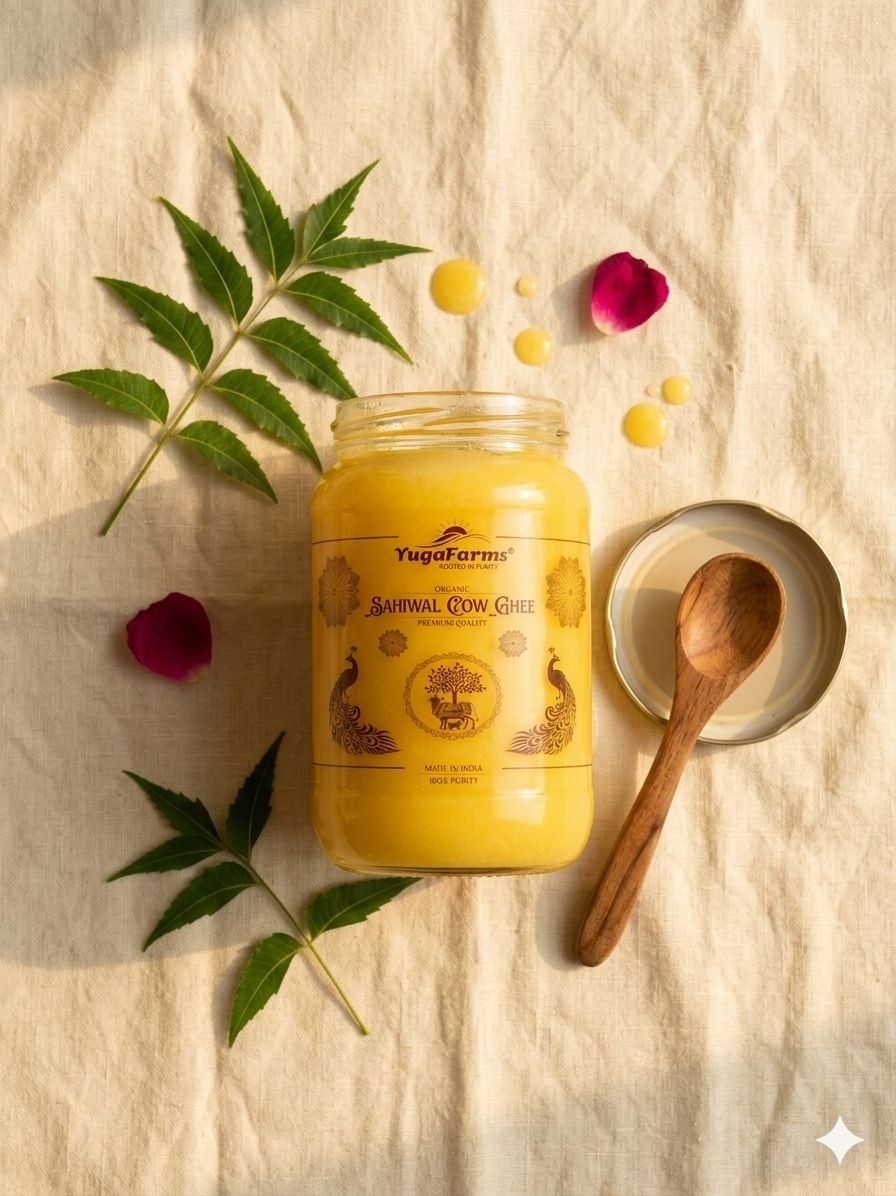
At YugaFarms, our ghee is made from Sahiwal A2 cows grazed on pasture in Haryana. It is processed using the traditional bilona method, FSSAI certified, and tested by an accredited third-party lab. The reports are available at yugafarms.com/lab-reports.
Frequently Asked Questions
Will ghee clog my pores? The comedogenic rating of ghee (how likely it is to block pores) is low to moderate. For most people — particularly those with dry or normal skin — ghee applied in small amounts is absorbed without clogging pores. If you have oily or acne-prone skin, test a small area first and observe for 48–72 hours before applying to the full face.
Can I use ghee on my baby's skin? Yes. Ghee has been used in India on newborns for centuries — as a massage medium and for dry skin patches. It is one of the safest topical options for infant skin, free of all the synthetic ingredients and preservatives that characterise commercial baby products. Use pure, good-quality ghee and warm it gently before applying.
Can I use ghee around my eyes for dark circles? Yes, very carefully. A tiny amount of ghee patted gently under the eye — not rubbed — is a traditional remedy for dark circles and under-eye dryness. The fat-soluble vitamins and vitamin K2 may support blood vessel integrity in the delicate under-eye area. Use consistently for at least 4–6 weeks before expecting visible results.
Is ghee better than coconut oil for hair? Different, not categorically better. Coconut oil's lauric acid penetrates the hair shaft more deeply, which is useful for reducing protein loss in chemically treated hair. Ghee's broader fatty acid profile makes it better for scalp moisturisation and gives a softer conditioning result. Many people use both for different purposes — coconut oil as a pre-wash treatment, ghee for scalp massage.
How often should I apply ghee to my face? For dry skin: nightly application is reasonable and beneficial. For normal skin: 3–4 times a week at night is a good starting point. For oily skin: once a week as a targeted treatment rather than a routine moisturiser. Always apply to clean, slightly damp skin for best absorption.
The Honest Summary
A2 Bilona ghee is not a miracle product. It will not reverse years of sun damage overnight, grow back hair that has been lost to hormonal causes, or replace targeted medical treatment for serious skin conditions.
What it will do, used consistently and correctly, is provide your skin and scalp with one of the most nutrient-dense, biocompatible topical fats available — without a single synthetic ingredient, without fragrance, without preservatives. It moisturises at the barrier level, delivers fat-soluble vitamins that your skin needs, and has genuine anti-inflammatory properties that support sensitive or compromised skin.
The practice has survived thousands of years because it works well enough to pass generation after generation. Modern cosmetic science doesn't contradict it — in many respects, it explains it.
Start with your hands. Or your heels. Or a small patch of dry skin that you've been struggling to fix with commercial products. Give it two to three weeks. Then decide.
YugaFarms produces small-batch A2 Sahiwal Bilona Ghee from our farm in Palwal, Haryana. FSSAI certified · ISO 9001:2015 · Lab reports publicly available. Use code FIRSTGHEE for 8% off your first order.